↧
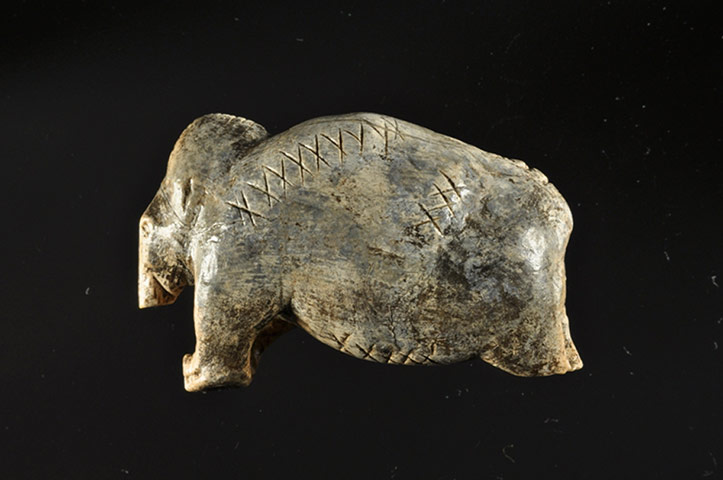
A gallery of Upper Palaeolithic portable art
↧
Archaeological News from Archaeology Magazine
Archaeological News from Archaeology Magazine:
Archaeological Headlines
Monday, December 10
by Jessica E. SaraceniArchaeologists Clive Ruggles of the University of Leicester and Nicholas Saunders of the University of Bristol spent five-year studying Peru’s Nazca Lines, including an elaborate labyrinth, walking along its paths and examining data collected through satellite digital mapping. They think the geoglyphs were created for walking by a few people at a time, probably for a spiritual or ritual purpose. “The labyrinth is completely hidden in the landscape, which is flat and virtually featureless. As you walk it, only the path stretching ahead of you is visible at any given point. Similarly, if you map it from the air its form makes no sense at all,” Ruggles explained.
Turkish authorities reportedly plan to appeal to the European court of human rights for the return of statues from the Mausoleum of Halicarnassus. Located in Bodrum, in southwestern Turkey, the pyramid-shaped monument to Mausolus, king of Caria, was built in 350 B.C. and topped with a sculpture of a four-horse chariot and decorated with other elaborate marble figures. It is thought to have collapsed during an earthquake sometime in the medieval period. “These pieces were acquired during the course of two British initiatives, both with firmans–legal permits issued by the Ottoman authorities–that granted permission for the excavation of the site and removal of the material from the site…to the British Museum,” responded a spokeswoman from the British Museum.
A small, secret room containing some 1,600 nineteenth-century artifacts has been discovered beneath an office block in Christchurch, New Zealand. A ladies’ fob watch, a brooch, mustard pots, cutlery, bottles, and china were among the objects found in the brick room. “The only thing we could think of was that the original house on that site must have been cleared out and everything thrown into a basement and buried and forgotten about,” said archaeologist Katharine Watson. She thinks the house was built after 1877 and demolished by 1916.
The DNA test results on the skeletal remains thought to belong to Richard III are due in the New Year. This article reviews the discovery of the skeleton, which was uncovered with a kink and an arrowhead in its spine and damage to its skull, in the remains of the Grey Friars church in Yorkshire. “I went into it with enthusiasm –but no great hopes of finding Richard III. It was a million to one chance. I said I’d eat my hat if we did. I really didn’t think we would find anything,” remembered Richard Buckley of the University of Leicester.
Friday, December 7
by Jessica E. SaraceniArchaeologists are searching New Zealand for Maori ovens that can be reliably dated because the superheated stones that line the ovens can help scientists learn how the Earth’s magnetic field has changed over the past 10,000 years. “We have very good palaeomagnetic data from across the world recording field strength and direction – especially in the Northern Hemisphere. The southwest Pacific is the gap, and in order to complete global models, we’re rather desperate for good, high-resolved data from our part of the world,” explained Gillian Turner from Victoria University. In fact, the volcanic boulders chosen by the Maori for use in their ovens contain a high concentration of magnetite, which is ideal for the scientists’ measurements.
Some 150 grape seeds dating to the first century A.D. have been unearthed at the Etruscan site of Cetamura del Chianti in Italy. The seeds were found in a waterlogged ancient well, so their DNA may have been preserved well enough for study. “We don’t know a lot about what grapes were grown at that time in the Chianti region. Studying the grape seeds is important to understanding the evolution of the landscape in Chianti. There’s been lots of research in other vineyards but nothing in Chianti,” explained Nancy Thomson de Grummond of Florida State University.
Thirty-two intact graves have been found in a 3,000-year-old cemetery in Pakistan’s Swat Valley. Most of those graves contained two skeletons, one male and one female, facing each other. Artifacts such as hairpins, spindles, pots, copper and bronze ornaments, and pieces of iron have also been found. “So these graves were opened, reopened, reburied and filled and emptied and refilled several times because [they belonged] to families who were using it for more than one generation,” explained Italian archaeologist Luca Maria Olivieri. The worked iron may be some of the oldest in the area.
A mass grave in Queensland holds the remains of 29 Pacific Islanders, some of the thousands of people who worked as indentured laborers in Australian sugar cane fields and on fruit plantations between 1863 and 1904. “Indentured labor is a term people use to soften the reality of what happened. Australia had an era of slavery,” said local leader Matthew Nagas.

↧
↧
misterhighboober: Mirrored compass diagrams


↧
Publishing Archaeology? How do archaeologists make arguments?
Publishing Archaeology? How do archaeologists make arguments?:
A critique of how archaeologists make arguments, particularly post-processualists. As I describe myself as a post-processualist, I was interested to see what the author had to say. Interesting because I’ve always held myself to what he writes at the end:
Here is how they suggest making arguments (chapter 8, “Making Good Arguments”):
What is the claim?
- What reasons support the claim?
- What evidence supports the reasons?
- Acknowledge alternatives / complications / objections
- What warrant or principle justifies connecting the reasons to the claim?
↧
Archaeological News: Researchers find clues to the Baltic Crusades in animal bones, horses and the extinct aurochs
Archaeological News: Researchers find clues to the Baltic Crusades in animal bones, horses and the extinct aurochs:
A multidisciplinary project seeks to understand the Eastern Baltic Crusades through the lens of ecology. Horses, for example, aided the Christians in battle, while the castles the Crusaders built decimated forests.
Stanford researchers have discovered that pagan villages plundered by medieval knights during the little-known Baltic Crusades had some problems in common with the modern-day global village.
Among them: deforestation, asymmetric warfare and species extinction.
According to a research paper published in Science, a project investigating the Baltic Crusades’ profound environmental legacy could yield valuable insight into colonialism, cultural changes and ecological exploitation – relevant issues not only throughout history, but especially in today’s increasingly globalized society.

↧
↧
Archaeological News: When Homo sapiens hit upon the power of art
Archaeological News: When Homo sapiens hit upon the power of art:
Rail engineer Peccadeau de l’Isle was supervising track construction outside Toulouse in 1866 when he decided to take time off to indulge his hobby, archaeology. With a crew of helpers, he began excavating below a cliff near Montastruc, where he dug up an extraordinary prehistoric sculpture….It is known today as the Swimming Reindeer of Montastruc.
Made from the 8in tip of a mammoth tusk, the carving, which is at least 13,000 years old, depicts two deer crossing a river. Their chins are raised and their antlers tipped back exactly as they would be when swimming. At least four different techniques were used to create this masterpiece: an axe trimmed the tusk, scrapers shaped its contours; iron oxide powder was used to polish it; and an engraving tool incised its eyes and other details.
It is superbly crafted, wonderfully observed and shows that tens of thousands of years ago human beings had achieved a critical intellectual status.

↧
Your parents (and Governor Rick Scott) were wrong - how to do almost anything with your anthropology degree
↧
cornellcas: Sorry if you were excited for it, but the world...

Sorry if you were excited for it, but the world probably isn’t ending Dec. 21, says Prof. John Henderson (anthropology). Hope you studied for your finals!
↧
ancientart: One fragment of the victory stele of the king...

↧
↧
culturalsecurity: Intelligence for Protection of Cultural...
Intelligence for Protection of Cultural Heritage
The tightening interrelation of cultural property and international security — cultural security — creates a need for the collection and analysis of specialized intelligence. “Cultural intelligence” enables assessments of the tactical and strategic significance of antiquities, fine art, and cultural heritage sites to national and regional security. This video, “Art of Cultural Intelligence,” presents a framework for the collection of cultural intelligence as a fundamental asset in countering threats to cultural security.
Looting of antiquities as a tactic in campaigns of cultural cleansing, trafficking in antiquities as a source of funding for insurgents, and targeting of historic structures and religious monuments in political violence represent distinct threats to regional security. A critical initial step in countering the threats includes marshaling appropriate sources of information. Publications that report on the art market and cultural property globally and players in the antiquities trade offer opportunities as sources of cultural intelligence.
Ultimately, the development of tactical and strategic cultural intelligence can reveal trafficking networks and assess risks to cultural heritage sites. As a starting point, this presentation identifies viable sources of cultural intelligence. Conflicts in Afghanistan (2001) and Iraq (2003) provide examples in retrospect, while volatility in Mali presents an opportunity in the context of an emerging security risk.
In conclusion, the presentation speculates on the applications of cultural intelligence in regional security.
Erik Nemeth delivered the presentation on a panel, “Archaeology in Conflict and the Military,” at the conference Archaeology in Conflict (www.archaeologyinconflict.org) in Vienna, Austria.
For similar news stories visit http://culturalsecurity.net/newssummary.htm
↧
Archaeological News: Restoration of Roman tunnels gives a slave's eye view of Caracalla baths
Archaeological News: Restoration of Roman tunnels gives a slave's eye view of Caracalla baths:

In the middle of a patch of grass amid the ruins of the Caracalla baths in Rome, there is a staircase that takes visitors deep into the ground to a world resembling the lair of a James Bond villain.
“This is our glimpse at maniacal Roman perfection, at incredible hydraulic technology,” said archaeologist Marina Piranomonte, as she descended and waved at a network of high and wide tunnels, each measuring six metres (20ft) high and wide, snaking off into the darkness.
The baths, on a sprawling site slightly off the beaten track in a city crowded by monumental attractions, hold their own against the nearby Circus Maximus, its shattered walls standing 37 metres high, recalling its second century heyday when it pulled in 5,000 bathers a day.
↧
Archaeological News: Archaeologists Uncover Europe's First Civilization
Archaeological News: Archaeologists Uncover Europe's First Civilization:
A team of archaeologists have unearthed additional evidence of what may have been Europe’s first civilization at a site located near the town of Pazardzhik in southern Bulgaria. Known as Yunatsite, it is a Tell (mound containing archaeological remains) about 110 meters in diameter and 12 meters high, rising above fields next to a small Bulgarian village by the same name. The Tell contains remains of an urbanized settlement dated at its earliest to the early fifth millenium BC.
Directed by Yavor Boyadzhiev of the National Institute of Archaeology and Museums, Bulgarian Academy of Sciences, excavators have unearthed artifacts such as weapons, Spondylus jewels, decorated fineware pottery, shards marked by characters/pictograms, and evidence of structures dated to 4900 BC, including fortifications and a recently discovered wooden platform that was likely the floor of a building that had been destroyed by fire.

↧
Archaeological News: Scientists seek to solve mystery of Piltdown Man
Archaeological News: Scientists seek to solve mystery of Piltdown Man:
It was an archaeological hoax that fooled scientists for decades. A century on, researchers are determined to find out who was responsible for Piltdown Man, the missing link that never was.
In December 1912, it was announced that a lawyer and amateur archaeologist named Charles Dawson had made an astonishing discovery in a gravel pit in southern England—prehistoric remains, up to 1 million years old, that combined the skull of a human and the jaw of an ape.
Piltdown Man—named for the village where the remains were found—set the scientific world ablaze. It was hailed as the missing evolutionary link between apes and humans, and proof that humans’ enlarged brains had evolved earlier than had been supposed.
It was 40 years before the find was definitively exposed as a hoax, and speculation about who did it rages to this day.

↧
↧
culturalsecurity: Documenting the Damage to Syria’s...

Documenting the Damage to Syria’s Archaeological Sites
Emma Cunliffe sits in a tiny graduate student’s office on the medieval campus of the University of Durham. But her mind is thousands of miles east, in Syria.
Every day she goes online, sometimes for a few hours, to monitor the Facebook feeds of local Syrian groups for word about damaged sites. She’ll scroll past horrific photos of dead children till she comes across mention of a new archaeological site that was shelled or plundered. She says it’s incredible just how much you can find out from these posts.
“It’s a new world online now,” she says. “The prevalence of social networking sites like Facebook, ease of access to YouTube, and the way that most people’s mobile phones can take video, means that, all those people who are desperate to share information have a real easy way to upload it and make it accessible.” Read more
For similar news stories visit http://culturalsecurity.net/newssummary.htm
↧
Evidence of World's 'Oldest' Cheese-Making Found
Evidence of World's 'Oldest' Cheese-Making Found:
Geographically and chronologically outside my archaeological wheelhouse, but I just love cheese and cheese history.
Truly an ancient art, no-one really knows exactly when humans began making cheese.
But now milk extracts have been identified on 34 perforated pottery vessels or “cheese-strainers”, which date back 7,500 years that have been excavated in Poland.
It is unambiguous evidence for cheese-making in northern Europe during Neolithic times, scientists believe, and the findings have been published in the scientific journal Nature.
“We analysed some fragments of pottery from the region of Kuyavia [Poland] pierced with small holes that looked like modern cheese-strainers,” says Melanie Salque, a postgraduate student at the University of Bristol’s Department of Chemistry.
↧
Time Team: the rise and fall of a television phenomenon

↧
antediluviana: “About Atlantis — some continent was submerged...

“About Atlantis — some continent was submerged away back, or some large body of land, for practically all peoples have legends about a flood. And the Cro-Magnons appeared suddenly in Europe, developed to a high state of primitive culture; there is no trace to show that they came up the ladder of utter barbarism in Europe. Suddenly their remains are found supplanting the Neanderthal Man, to whom they have no ties of kinship whatever. Where did they originate? Nowhere in the known world, evidently. They must have originated in some land which is not now known to us.” (Collected Letters of Robert E. Howard, p. 237)
Copyright © 2012 Antediluviana. All rights reserved.
↧
↧
ancientpeoples: The Sun God Tablet, Limestone Found Sippar,...

The Sun God Tablet, Limestone
Found Sippar, Iraq
c. 860-850 BCE
Babylonian
Limestone tablet: the scene sculptured in relief at the head of the tablet represents Nabu-aplu-iddina being led by the priest Nabu-nadin-shum and the goddess Aa into the presence of the Sun-god, who is seated within Ebabbara. Before the god is the solar disc, resting upon an altar which is supported by ropes held by attendant deities, whose bodies spring from the roof of the shrine. In the field above the Sun-god, and within the shrine, are a lunar disc, a solar disc and an eight-pointed star, the symbols of Sin, Shamash and Ishtar. The god wears a horned headdress and carries the ringed rod in his right hand. The shrine is represented as resting on the heavenly ocean. The engraved text contains a record of Nabu-apla-iddina’s re-endowment of the Sun-Temple at Sippar. The inscription is engraved in six columns, three upon the obverse and three upon the reverse; and the upper part of the obverse is occupied by a scene sculptured in low relief; the edges of the tablet are bevelled.
Source: British Museum
↧
thesherd: Ancient Roman road, part of the Via Quintana,...

Ancient Roman road, part of the Via Quintana, discovered beneath York Minster. (via Roman road uncovered in York (From York Press))
↧
deconversionmovement: Top 7 Human Evolution Discoveries From...

Top 7 Human Evolution Discoveries From South Africa
South Africa plays a central role in the history of paleoanthropology. Anthropologists and other scientists of the 19th and early 20th century balked at the possibility that Africa was humankind’s homeland—until an ancient hominid was unearthed in South Africa in 1924. Since then, Africa has become the center of human evolution fieldwork, and South Africa has produced a number of iconic hominid fossils and artifacts. Here is a totally subjective list of the country’s most important hominid discoveries.
Taung Child: In 1924, anatomist Raymond Dart pried a tiny fossilized partial skull and brain from a lump of rock. The bones were the remains of a child. The youngster looked like an ape, but Dart also recognized some human qualities. He decided he had found a human ancestor that was so ancient it was still ape-like in many ways. (Later, scientists would determine the bones were nearly three million years old). Dart named the hominid Australopithecus africanus. The Taung Child, known by the name of the place where the fossils came from, was the first australopithecine ever discovered—and the first early hominid found in Africa. After the discovery, anthropologists who were searching for humanity’s origins in Europe and Asia switched their attention to Africa.
Mrs. Ples: Throughout the 1930s and 1940s, paleontologist Robert Broom led the efforts to find hominids in South Africa. He scoured the region’s limestone caves and quarries—the Taung Child came from a quarry—and was well rewarded for his efforts. Of the numerous fossils he uncovered (sometimes with the help of dynamite), his most influential find was a roughly 2.5-million-year-old skull of an adult female hominid now known as Mrs. Ples. Unearthed in 1947 at a site called Sterkfontein, the skull was well preserved and displayed the same mix of ape and human features seen in the Taung Child. Finding an adult version of A. africanus helped convince skeptics that the species was an ancient human ancestor. Some anatomists had thought Taung was just an ape and would have developed more pronounced ape-like features, and lost its human-like traits, as it grew up. Instead, Mrs. Ples showed that the species retained its mix of human and ape traits throughout life.
STS 14: Another one of Broom’s key finds is a set of well-preserved post-cranial bones that includes a pelvis, partial spine, ribs and upper thigh. Like Mrs. Ples, these fossils were found in 1947 at Sterkfontein and date to about 2.5 million years ago. The bones are officially known as STS 14 (STS refers to Sterkfontein) and presumably belonged to an A. africanus individual. The shape of the pelvis and spine are remarkably modern, and the find was some of the first evidence that early human ancestors walked upright on two legs.
SK 48: In addition to finding a trove of A. africanus specimens, Broom, along with his many assistants, discovered a new hominid species: Paranthropus robustus. The first hints of the species came in 1938 when Broom acquired a jaw fragment and molar that were much larger and thicker than any fossils belonging to A. africanus. Broom collected more of the unusual fossils and then hit the jackpot in 1950. A quarry worker found a nearly complete skull of an adult hominid that had giant teeth and a flat face. The fossil is officially called SK 48 (SK refers to the cave of Swartkrans where the skull was found). The collection of fossils with big chompers, which the hominids used to chew tough foods, was given the name P. robustus, which lived in South Africa about 1.8 million to 1.2 million years ago.
Little Foot: In the early 1990s, anthropologist Ron Clarke of South Africa’s University of the Witwatersrand found four small australopithecine foot bones at Sterkfontein. Later, Clarke and his colleagues discovered a nearly complete skeleton embedded in limestone that belonged to the foot. The researchers are still carefully chipping away at the rock to release the skeleton, dubbed Little Foot, but they have already noted that the individual has some characteristics not seen in any other known species of Australopithecus. But since the bones haven’t been fully studied and shared with other scientists, it’s hard to know where the hominid sits in the family tree, Science reported last year. It’s also hard to know exactly how old it is. Clarke’s team places the fossils at 3.3 million years old while other groups using different dating methods say Little Foot is more like 2.2 million years old. Science reported that Little Foot was expected to be fully liberated from its rocky enclosure sometime this year. As far as I know, that hasn’t happened yet.
Australopithecus sediba: The most recent major hominid fossil discovery in South Africa occurred in 2010. Lee Berger of the University of the Witwatersrand led a team that found two partial hominid skeletons at Malapa Cave. Dating to nearly two million years ago, the skeletons indicate that these hominids had their own unique style of walking and spent time both on the ground and in trees. X-ray scans of one of the skulls reveals that some aspects of the brain were more modern than in previous species. Berger and his colleagues therefore think the species, which they named A. sediba, could have given rise to the genus Homo.
Origins of Modern Behavior: Fossils aren’t the only major human evolution discoveries from South Africa. Several coastal cave sites have been treasure troves of artifacts that reveal when and how sophisticated behavior and culture emerged in early populations of Homo sapiens. There have been too many of these discoveries to single any one out. Some of these finds—such as red pigments used 164,000 years ago and shell beads dating to 77,000 years ago—are among the earliest evidence for symbolic thinking in our ancestors. Other artifacts, like 71,000-year-old projectile weapons, indicate early humans could construct complicated, multipart tools that require a lot of planning and foresight to make.
↧