
Dur Sharrukin (Khorsabad), the ruins of the King’s Palace, 721-705 B.C.; the state in 1966.
Dur Sharrukin (Khorsabad), the ruins of the King’s Palace, 721-705 B.C.; the state in 1966.
New Open Access Fasti Article
http://www.fastionline.org/folderindex.php?view=serieshome&ste_cd=FOLDER-it
Culture
Harappa (by a2portfolio)
“Harappa is an archaeological site in Punjab, northeast Pakistan, about 35 km (22 mi) west of Sahiwal. The site takes its name from a modern village located near the former course of the Ravi River. The current village of Harappa is 6 km (4 mi) from the ancient site. Although modern Harappa has a train station left from the British times, it is today just a small (pop. 15,000) crossroads town. The site of the ancient city contains the ruins of a Bronze Age fortified city, which was part of the Cemetery H culture and the Indus Valley Civilization, centered in Sindh and the Punjab. The city is believed to have had as many as 23,500 residents—considered large for its time. The ancient city of Harappa was greatly destroyed under the British Raj, when bricks from the ruins were used as track ballast in the making of the Lahore-Multan Railroad.”
This gold earring, covered in ibex (wild goat) decorations, was recently discovered at Tel Megiddo in northern Israel. For thousands of years, it, along with other pieces of jewelry, lay wrapped in textiles and hidden in a dirt-filled jug. Even after archaeologists from Tel Aviv University dug up the vessel, they didn’t immediately unearth its valuable contents — first, they had to analyze the outside of the ceramic container.
The Tel, or archaeological mound, at Megiddo has very distinct strata that mark different time periods, and knowing the layer in which the jug was discovered allowed researchers to date the jewelry to around 1100 BCE, the period when Tel Megiddo was a large Canaanite city-state. Some of the jewelry’s materials and designs, however, are similar to Egyptian ones, and may have originated either in Egypt or with a craftsman who had been influenced by other Egyptian jewelry. Either explanation is possible: at the time, Egypt’s control over the area was just ending. Perhaps a Canaanite woman purchased these pieces to wear, hid them away when fleeing her home during the Egyptian withdrawal, and then never returned.
For more details, check out the full story at American Friends of Tel Aviv University or EurekAlert
ScienceDaily (May 10, 2012) — Evidence for a forgotten ancient language which dates back more than 2,500 years, to the time of the Assyrian Empire, has been found by archaeologists working in Turkey

You could almost say that Prague keeps getting older. Not long ago, archaeologists found evidence of the oldest ploughed field here, tended five and a half thousand years ago. Now the imprints of structures have been found in the same location, dating back even further, some 7,500 years.
“The dates of the earliest settlements in the area of Prague are continuously being pushed back – just about anytime someone puts a shovel to the northern district of Bubeneč. The spot in the bend of the Vltava river apparently offered an unparalleled living space, a river terrace with fresh water in plenty, defence on three sides and fertile land. The site makes headlines again and again as the ground yields up fascinating finds from the mysterious peoples who inhabited Central Europe before the Europeans. That they farmed in at least 3500 BC, and that they lived there long before that, is well known. Now though comes the first hard evidence of a settlement as old as agriculture on the Nile, from around 5500 BC. Radek Balý is the director of the Czech Archaeological Society and heads the team that made the find.
“We found two longhouses from the Neolithic. One of the big houses was rectangular in shape and was about 7,000 years old. The other was trapezoidal and was about 6,500 years old. The only remnants of the buildings that we found were the holes and grooves left by wooden structures, so we know the circumference and have a few relics of the way the houses were divided. We also found a burial that was composed of big ceramic pottery full of pieces of ashes and bones, standing on a big, flat stone. It was covered by a small bowl and two other flat stones. That find is about 3,000 years old. We found another grave in the research area, but it was very disrupted. We can say that it was much older, but that’s all we can say for now.”
Read More Here: http://www.radio.cz/en/section/curraffrs/prague-district-yields-up-evidence-of-5500-bc-settlement
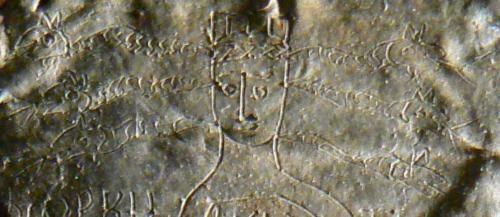
“At a time when black magic was relatively common, two curses involving snakes were cast, one targeting a senator and the other an animal doctor, says a Spanish researcher who has just deciphered the 1,600-year-old curses.
Both curses feature a depiction of a deity, possibly the Greek goddess Hekate with serpents coming out of her hair, possibly meant to strike at the victims. Both curses contain Greek invocations similar to examples known to call upon Hekate. The two curses, mainly written in Latin and inscribed on thin lead tablets, would have been created by two different people late in the life of the Roman Empire. Both tablets were rediscovered in 2009 at the Museo Archeologico Civico di Bologna, in Italy, and were originally acquired by the museum during the late 19th century. Although scholars aren’t sure where the tablets originated, after examining and deciphering the curses, they know who victims of the curses were”
Read More Here: http://www.livescience.com/20483-black-magic-ancient-curses.html

A MYSTERIOUS shipwreck that lay in the Solent for 160 years has finally been identified by archaeologists, and its fascinating history revealed for the first time.
“The wreck, which lies on the Horse Tail Sands three miles east of Bembridge, was first discovered by fishermen in 2003, but it was another eight years before archaeologists from the Hampshire and Wight Trust for Maritime Archaeology were able to put a name to the vessel.
Its identity has been revealed to conincide with the release of a new book about the history of the wreck.
The trust said the wreck was that of the Flower of Ugie, a 19th century wooden sailing barque that sank in the Solent on December 27, 1852 following a great storm in the English Channel.
The vessel was a three-masted sailing barque built in Sunderland in 1838. During its career it made regular voyages around Africa and onto India and the Far East.”
Read More Here: http://www.iwcp.co.uk/news/news/archaeologists-identify-mystery-shipwreck-44506.aspx
Archaeologists working along the route of Bulgaria’s Struma Motorway, which when completed will lead from capital city Sofia to the Greek border, have found a necropolis estimated to date back about 2800 years, public broadcaster Bulgarian National Television said on May 1 2012.
TO READ MORE, CLICK THROUGH.
Click through for link with more photos.
Via Flickr
Artifacts, Sites, Books, Shovels, Dirt, Etc
Old & New Ceramics, Glassware, Metals, and Woods.
Places I wish to go & fully experience.

A team of archaeologists from the Université libre de Bruxelles (ULB) has discovered a spectacular tomb containing more than eighty individuals of different ages. This discovery — provisionally dated to around 1000 years ago — was made at the site of Pachacamac, which is currently under review for UNESCO World Heritage status.
Pachacamac, situated on the Pacific coast about thirty kilometres from Lima, is one of the largest Prehispanic sites in South America. Professor Peter Eeckhout — under the auspices of the ULB — has been carrying out fieldwork at the site for the past 20 years. The 2012 season resulted in some particularly remarkable discoveries.
The Ychsma Project team undertook to record and excavate a series of Inca storage facilities (15th-16th c. AD), as well as a more ancient cemetery which had been detected during exploratory work in 2004.
The Lyngby Axe from England, dating to 8000 BCE
The British Museum
“This trimmed reindeer antler was found in a gravel pit by the River Nene. It is one of a small number of finds which links Britain to Europe at the very end of the last Ice Age, or Late Glacial period. At this time, although the climate was getting warmer, sea levels were still low because much water was still frozen up in sea ice further north. Thus dry land still linked Britain to Europe. Worked axe-like reindeer antlers are characteristic artefacts of this period in Denmark, the Netherlands and northern Germany. They are called Lyngby axes after a Danish findspot. The discovery of this particularly large example in Earls Barton shows that hunter-gatherers of this Ahrensburgian period also spread across the land bridge to England. They were possibly following reindeer herds, which were their main source of food and materials.
The ‘axe’ was made by cutting off the top of the antler, and several of the tines. The beam of the antler then served as the axe shaft or handle with one of the tines as the blade. We can not be certain how the object was used. It would have been an effective weapon used as a club perhaps with a flint blade fixed into the tine socket. However, this does not explain the smooth polished tine blade edge, which suggests that it might have been used as a tool on a soft material.”
Gnawed Roman skeleton that inspired Sylvia Plath poem goes on display
The skeleton of a Roman woman and the bones of the mouse and shrew that gnawed her ankle in her coffin, inspiring one of Sylvia Plath’s most haunting poems, have gone on display.
Plath saw the massive stone sarcophagus and its contents soon after it was excavated in the 1950s, when she was a student at Cambridge.
Staff at the university’s Museum of Archaeology and Anthropologymounted the rodent bones on a piece of card – also on display again – and showed them in the coffin alongside the remains of the middle-aged woman, which is grimacing as if in pain.
The viewing prompted Plath’s 1957 poem All the Dead Dears, in which she describes “this antique museum-cased lady” and the “gimcrack” bones of the rodents “that battened for a day on her ankle-bone”, and fears that the “barnacle dead”, strangers or members of her family will drag her down and suck her life away. Six years later, the poet killed herself.
The sarcophagus, with its inner lead coffin, was one of a group of high-status burials discovered by chance by builders clearing land for a housing estate at Arbury, on the outskirts of Cambridge.
Bracelet with scarab
From Tutankhamun’s tomb, located in the Valley of the Kings, Egypt.
18th dynasty (New Kingdom), 1332-1323 B.C.E.


