A projectile point dating to 13,800 years ago, found embedded in a mastodon bone, precedes Clovis hunters, the culture often thought as the first to roam the Americas.
A projectile point dating to 13,800 years ago, found embedded in a mastodon bone, precedes Clovis hunters, the culture often thought as the first to roam the Americas.
Linear Enamel Hypoplasia (LEH) is a dental defect caused by periods of enamel deficiency, which occur during the formation of permanent teeth in early childhood (Wood, 1996). LEH in permanent teeth is usually the result of episodic childhood disease or malnutrition that occurs roughly within the first six or seven years of life (Maclellan, 2005).
Once the mature tooth has erupted, LEH typically presents itself as transverse striations or bands near the crown of the tooth, but it can also manifest as small pits of reduced thickness in the tooth’s enamel (Wood, 1996).
The emergence of deciduous and permanent teeth occurs at a known rate, and by measuring the distance between the LEH and the cement-enamel junction (CEJ; where the enamel covered crown meets the cementum covered root), the age at which specific episodes of illness occurred can be determined (Maclellan, 2005).
While the skeletal remains of children are generally underrepresented in the archaeological record, studying LEH in adult remains can help capture and reconstruct the nature of childhood – of the stressors that acted upon their bodies and their social circumstances – in a particular area at a particular time (Maclellan, 2005).
photo source (otisarchives1)
Maclellan, E. (2005). Linear enamel hypoplasia: What can it say about the condition of childhood?. Totem: The University of Western Ontario Journal of Anthropology, 13(1), 40-52. Retrieved from http://ir.lib.uwo.ca/totem/vol13/iss1/7
Wood, L. (1996). Frequency and chronological distribution of linear enamel hypoplasia in a north american colonial skeletal sample. American Journal of Physical Anthropology, 100, 247-259. doi: 10.1002/(SICI)1096-8644(199609)101:1<135::AID-AJPA10>3.0.CO;2-1
#historyteacher
“Man’s BEST friend?” OR “Turning Wolves Into Hounds”.
Click the link (above) to go to a great post from Heather Pringle on the excellent “Last Word On Nothing” (www.lastwordonnothing.com) science blog about how the domestication of dogs may have given Homo Sapiens an advantage over Neaderthal in the hunting of food, and reaped all of the benefits in nutrition.
National Geographic Special - Cradle of the Gods
About new theories and amazing discoveries in Göbekli Tepe (Turkey)
Early humans, part of the zoological order of primates, began to create basic stone tools and usher in the Stone Age, a period of human history from 2.5 million years ago to 5,000 years ago. Due to the lack of written texts in prehistory, little is known about this period, but it is widely accepted that Homo sapiens evolved about 150,000 years ago in the area of East Africa’s Rift Valley and migrated out from there (known as the “Out of Africa” thesis).
Homo sapiens migrated through Africa from 150,000 to 100,000 years ago, and from there to the Middle East, Asia, India/Southeast Asia, and China by 67,000 years ago. Then, from around 50,000 years ago, they migrated to Australlia/Oceania.
Migration Europe and Central Asia was delayed, however, thanks to the cooler climates of the Pleistocene Ice Age, but settlements were made there by 40,000 years ago.
Migration to the Americas is still debated. Most scholars believe that Homo sapiens were able to cross from Eurasia over the Bering Strait land bridge to Alaska during a period of heavy glaciation.
The Stone Age is called so because of the many stone tools found by archaeologists from this period. Homo sapiens created various, basic tools from bone, wood, animal skins, sinews, and the long preserved stone.
The Stone Age covers a period of time from 2.5 million to 6,000 years ago. It is divided to into the Paleolithic period (“early Stone Age” of 12,000 years ago), the Mesolithic period (12,000 to 10,000 years ago), and the Neolithic period (“new Stone Age”, begining 8000 BC).
The Paleolithic over laps the Pleistocene epoch and it’s recurring ice ages, which brought the global climate to the lowest it’s ever been 22,000 to 18,000 years ago.
The discovery of a new fossil primate in Myanmar, formerly known as Burma, illuminates a critical step in the evolution of early anthropoids, which is the group that includes humans, apes and monkeys, an international team of researchers has announced.
It also builds on evidence that anthropoids — humans’ early ancestors — originated in Asia before migrating to Africa where humans would evolve many millions of years later.
It also helps counter long-held theories that anthropoid evolution was rooted in Africa.
Omens based on eclipses, Assyria, 7th century B.C.E.
London, British Museum, inv. K3561I wonder if they have anything referring to the Transit of Venus…
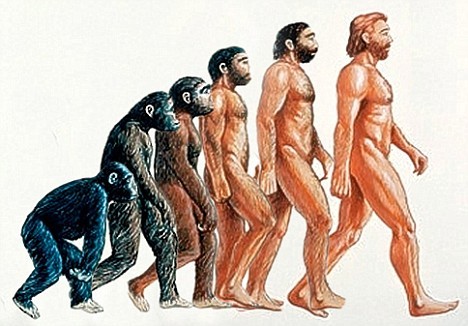
I hate how every “evolution of man” drawing has man getting whiter as they get closer to modern man. That’s not even how it happened! As hominins lost body hair we got darker and only in the last 100,000 years (more likely less than 50,000) have homo sapiens evolved light skin in the geographic regions we see today. Stuff like this totally promotes the idea that being white means you are of a higher evolutionary level and I would like it to please GET OUT OF MY SCIENCE.
Tel Aviv University researchers have found that the ancient Egyptians developed unique system of volume measurement based on sphere units.
Vessel supported by two rams from Ur’s Early Dynastic III Era 2600-2500 BCE. The Metropolitan Museum of Art, New York City, NY.
Photo by Babylon Chronicle
The “Plain of Jars” (by magical-world)
The Plain of Jars, dated to the Iron Age (500 BCE to 500 CE), is one of the most fascinating archaeological landscapes in Asia. There are more than 90 sites in the province of Xien Khouang, Laos and each site ranges from 1 to 400 jars. This megalithic landscape plays an important role in studying Southeast Asian prehistory.
In February 2011, Chinese National Geographic magazine published a series of exquisite pictures about Shicheng City (literally, Lion City), and since then, the public’s strong interest in the city has been aroused again.
The city of nearly 1,339 years of age, situated in east China’s Zhejiang Province, has been submerged under Qiandao Lake since 1959 for the construction of the Xin’an River Hydropower Station.
International archeologists vividly named the city submerged in water “time capsule.” Since it is shielded from the erosion by wind, rain and sun, a city submerged in water comparatively maintains a stable condition, thus making the city a virtual time vessel. Seen from the pictures of Shicheng City, stairs in ancient houses, walls and memorial arches remain the same as they were thousands of years ago.
Shicheng City was named after the Wu Shi Mountain (literally, Five Lion Mountain) in the northern part of Sui’an County, Zhejiang. It was once the center of politics, economics and culture of Sui’an County in that area.
As written in the “History of Sui’an County,” there are all together 265 arches submerged under Qiandao Lake, among which the Jie Xiao Memorial Arch’s fine carvings remain well-preserved.
According to the restored map of Shicheng, there were five city gates in all directions. You can find one city gate tower on each city gate and all together there are five towers. Besides, six streets in Shicheng City were used to connect every corner of the city as a whole. The typical roads in Shicheng City were stone roads, tidily paved by flagstone and pebbles.
Another look at a nearly 80-year-old pottery collection at the Arizona State Museum is yielding new information about migrants who abandoned the Four Corners region.
Approximately eight centuries ago, people living along the Colorado Plateau in what is now the Four Corners area faced a crisis. Environmental changes that devastated their agricultural practices and likely aggravated social unrest forced significant numbers of these people to move away.
Many of them headed south into central and southern Arizona and western New Mexico, into lands already inhabited by well-established groups.
What is remarkable about this diaspora is that while there is no written record of what happened, much of what archaeologists know is told in the ceramic bowls, plates and figurines that were created and left behind when those civilizations later collapsed.
Archaeologists in the eastern Mediterranean region have been unearthing spherical jugs, used by the ancients for storing and trading oil, wine, and other valuable commodities. Because we’re used to the metric system, which defines units of volume based on the cube, modern archaeologists believed that the merchants of antiquity could only approximately assess the capacity of these round jugs, says Prof. Itzhak Benenson of Tel Aviv University’s Department of Geography.
Now an interdisciplinary collaboration between Prof. Benenson and Prof. Israel Finkelstein of TAU’s Department of Archaeology and Ancient Near Eastern Cultures has revealed that, far from relying on approximations, merchants would have had precise measurements of their wares — and therefore known exactly what to charge their clients.
The researchers discovered that the ancients devised convenient mathematical systems in order to determine the volume of each jug.