“A dictionary of thousands of words chronicling the everyday lives of people in ancient Egypt — including what taxes they paid, what they expected in a marriage and how much work they had to do for the government — has been completed by scholars at the University of Chicago.
The ancient language is Demotic Egyptian, a name given by the Greeks to denote it was the tongue of the demos, or common people. It was written as a flowing script and was used in Egypt from about 500 B.C. to 500 A.D., when the land was occupied and usually dominated by foreigners, including Persians, Greeks and Romans.
The language lives on today in words such as adobe, which came from the Egyptian word for brick. The word moved through Demotic, on to Arabic and eventually to Spain during the time of Islamic domination there, explained Janet Johnson, editor of the Chicago Demotic Dictionary. “
Archaeological News: Chicago Demotic Dictionary refines knowledge of influential language
History.Travel. Music: AZERBAIJAN : Eneolithic artefacts discovered in Azerbaijan
See on Scoop.it – Travels on the net
“The Archaeology and Ethnography Institute has discovered in the ancient village of Shahtakhti artifacts dating back to the Eneolithic age (fourth millennium BC), research officer Ghahraman Aghayev told Trend on Friday.”
See on …
Unique tombs found in Philippines (Update)
In this March 1, 2011 photo released by the Philippine National Museum, Filipino archeologists measure the dimensions of a limestone coffin at Mount Kamhantik, near Mulanay town in Quezon province, eastern Philippines. Archeologists have unearthed remnants of what they believe is a 1,000-year-old village on a jungle-covered mountaintop in the Philippines with limestone coffins of a type never before found in this Southeast Asian nation, officials said, Thursday, Sept. 20, 2012. (AP Photo/Philippine National Museum)
Archaeologists have unearthed remnants of what they believe is a 1,000-year-old village on a jungle-covered mountaintop in the Philippines with limestone coffins of a type never before found in this Southeast Asian nation, officials said Thursday.
National Museum official Eusebio Dizon said the village on Mount Kamhantik, near Mulanay town in Quezon province, could be at least 1,000 years old based on U.S. carbon dating tests done on a human tooth found in one of 15 limestone graves he and other archaeologists have dug out since last year.
The discovery of the rectangular tombs, which were carved into limestone outcrops jutting from the forest ground, is important because it is the first indication that Filipinos at that time practiced a more advanced burial ritual than previously thought and that they used metal tools to carve the coffins.
Past archaeological discoveries have shown Filipinos of that era used wooden coffins in the country’s mountainous north and earthen coffins and jars elsewhere, according to Dizon, who has done extensive archaeological work and studies in the Philippines and 27 other countries over the past 35 years.
Aside from the tombs, archaeologists have found thousands of shards of earthen jars, metal objects and bone fragments of humans, monkeys, wild pigs and other animals in the tombs. The limestone outcrops had round holes where wooden posts of houses or sheds may have once stood, Dizon told The Associated Press in an exclusive interview.
Click title to read more.
Archaeologists discover funerary chamber more than a 1,000 years old in Michoacan

MICHOACAN.- The discovery of a funerary chamber of more than a 1,000 years old, in the Archaeological Zone of Tingambato Michoacan, with an unidentified character’s burial, accompanied by 19,000 green stone beads, shells and human bones, is one of the most outstanding results of a special archaeological investigation and conservation project by INAH in five different pre Hispanic sites in this zone.
According to the archaeologists of the National Institute of Anthropology and History (INAH-Conaculta), the architectural complexity of the mortuary chamber and the burial’s wealth (which belong to the Classic period [200 through 900 AD]) indicate that the remains belong to a high ranking character from the ancient metropolis of Tingambato.
The cultural particulars of the burial haven’t been identified yet, but it’s inferred that the chamber matches the funerary traditions of the West, such as shaft tombs and the tombs of El Opeño, although these we built during the Pre Classic period (300 through 200 BC) and continuing through the Classic period (400 through 600 AD).
Archaeologist Melchor Cruz, coordinator of the conservation and investigation works of Tingambato, reported that the characteristics that have dominated in Tomb II and the wealth of the burial indicate that Tingambato must have had a major importance in the pre Hispanic culture of this region, which until now “could have been a governing center of the Classic Mesoamerican period, in the central region of what today is Michoacan”.
The funerary space is composed of a sandstone ceiling, these stones were thoroughly worked to make narrow and long shapes, one on top of the other, glued together with mud, and arranged counter clockwise; the walls are covered with a stucco made of vegetable fibers. This sepulcher is added to the one discovered in 1979, Tomb I of Tingambato, by archaeologist Roman Piña Chan.
Melchor Cruz said that the quantity of shell beads that were found in the chamber convey possible relation to the ancient settlers of Tingambato with other towns in the coast. Also, it shows that this city could have been a possible strategic point in a commercial route to Cuenca de Patzcuaro.
“The burial’s arrangement was a complete paraphernalia: we found hundreds of beads carved in rectangular and square shapes, snail shells of about two through eight millimeters (0.07 and 0.31 inches) tall; some of those materials were probably used for necklaces and covered the human skeleton up to the thorax and the arms; underneath the individual’s remains we found a layer of sandstone placed on the floor of the funerary chamber.”
It was in July 2011, through the Michoacan Special Project, that after three decades, they renewed the explorations of Tingambato, parallel to the major maintenance work of ancient buildings.
The discovery was registered while the grass was being trimmed and remains of pre Hispanic archaeology were being searched for. A worker put his foot in a hole made by a mole and his foot sank 10 centimeters (3.93 inches) until it stopped on hard ground. To verify what this was, archaeologist Melchor Cruz introduced his hand in the hole and touched a piece of sandstone, he then thought this might be a tomb.
This is the second tomb that is discovered in this site. The specialist said that this tomb was different than the mortuary chamber found in 1979 since this one has a more complex structure in the chamber walls, the buttresses of the ceiling and the stucco cover.
fourteenth: 700BC-650 BCE Assembled from fragments; the shell...

700BC-650 BCE
Assembled from fragments; the shell served as a container for cosmetics.
E .MEDITERRANEAN -PHOENICIAN found probably in Vulci Italy.
ancientart: Figure from the Chinese Terracotta Army, 210...
archaeoadventuretime: Visited the Ska-Nah-Doht Iroquoian...


Visited the Ska-Nah-Doht Iroquoian village today. Had fun walking the trails, and luckily we didn’t get lost in the maze of a palisade around the rebuilt village. The village includes 3 longhouses that you can go inside and even lay on the beds. One interesting fact is that those the bed-like structures on stilts were used as a place to keep the dead until their bones could later be buried in large ossuaries.
euralmanac: Mammoth found frozen in Russia after 30,000...
Mammoth found frozen in Russia after 30,000 years
Scientists hail the discovery of the remains of a 30,000-year-old frozen mammoth, found by an 11-year-old boy in northern Russia. It took a week to excavate the animal using a steamer to thaw the permafrost. Scientists hope the discovery may help them find an answer to why the extinct beasts were hunch-backed (via guardian.co.uk)
Neolithic Discovery: Why Orkney is the Centre of Ancient Britain
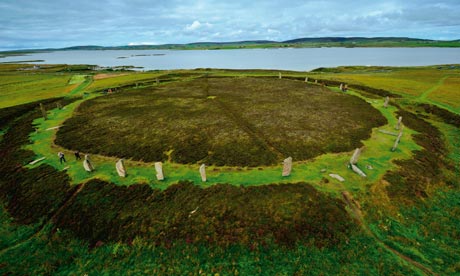
Drive west from Orkney’s capital, Kirkwall, and then head north on the narrow B9055 and you will reach a single stone monolith that guards the entrance to a spit of land known as the Ness of Brodgar. The promontory separates the island’s two largest bodies of freshwater, the Loch of Stenness and the Loch of Harray. At their furthest edges, the lochs’ peaty brown water laps against fields and hills that form a natural amphitheatre; a landscape peppered with giant rings of stone, chambered cairns, ancient villages and other archaeological riches.
This is the heartland of the Neolithic North, a bleak, mysterious place that has made Orkney a magnet for archaeologists, historians and other researchers. For decades they have tramped the island measuring and ex- cavating its great Stone Age sites. The land was surveyed, mapped and known until a recent chance discovery revealed that for all their attention, scientists had completely overlooked a Neolithic treasure that utterly eclipses all others on Orkney – and in the rest of Europe.
This is the temple complex of the Ness of Brodgar, and its size, complexity and sophistication have left archaeologists desperately struggling to find superlatives to describe the wonders they found there. “We have discovered a Neolithic temple complex that is without parallel in western Europe. Yet for decades we thought it was just a hill made of glacial moraine,” says discoverer Nick Card of the Orkney Research Centre for Archaeology. “In fact the place is entirely manmade, although it covers more than six acres of land.”
Once protected by two giant walls, each more than 100m long and 4m high, the complex at Ness contained more than a dozen large temples – one measured almost 25m square – that were linked to outhouses and kitchens by carefully constructed stone pavements. The bones of sacrificed cattle, elegantly made pottery and pieces of painted ceramics lie scattered round the site. The exact purpose of the complex is a mystery, though it is clearly ancient. Some parts were constructed more than 5,000 years ago.
The people of the Neolithic – the new Stone Age – were the first farmers in Britain, and they arrived on Orkney about 6,000 years ago. They cultivated the land, built farmsteads and rapidly established a vibrant culture, erecting giant stone circles, chambered communal tombs – and a giant complex of buildings at the Ness of Brodgar. The religious beliefs that underpinned these vast works is unknown, however, as is the purpose of the Brodgar temples.
“This wasn’t a settlement or a place for the living,” says archaeologist Professor Colin Richards of Manchester University, who excavated the nearby Barnhouse settlement in the 1980s. “This was a ceremonial centre, and a vast one at that. But the religious beliefs of its builders remain a mystery.”
What is clear is that the cultural energy of the few thousand farming folk of Orkney dwarfed those of other civilisations at that time. In size and sophistication, the Ness of Brodgar is comparable with Stonehenge or the wonders of ancient Egypt. Yet the temple complex predates them all. The fact that this great stately edifice was constructed on Orkney, an island that has become a byword for remoteness, makes the site’s discovery all the more remarkable. For many archaeologists, its discovery has revolutionised our understanding of ancient Britain.
“We need to turn the map of Britain upside down when we consider the Neolithic and shrug off our south-centric attitudes,” says Card, now Brodgar’s director of excavations. “London may be the cultural hub of Britain today, but 5,000 years ago, Orkney was the centre for innovation for the British isles. Ideas spread from this place. The first grooved pottery, which is so distinctive of the era, was made here, for example, and the first henges – stone rings with ditches round them – were erected on Orkney. Then the ideas spread to the rest of the Neolithic Britain. This was the font for new thinking at the time.”
It is a view shared by local historian Tom Muir, of the Orkney Museum. “The whole text book of British archaeology for this period will have to be torn up and rewritten from scratch thanks to this place,” he says.
Farmers first reached Orkney on boats that took them across the narrow – but treacherously dangerous – Pentland Firth from mainland Scotland. These were the people of the New Stone Age, and they brought cattle, pigs and sheep with them, as well as grain to plant and ploughs to till the land. The few hunter-gatherers already living on Orkney were replaced and farmsteads were established across the archipelago. These early farmers were clearly successful, though life would still have been precarious, with hunting providing precious supplies of extra protein. At the village of Knap o’Howar on Papay the bones of domesticated cattle, sheep and pigs have been found alongside those of wild deer, whales and seals, for example, while analysis of human bones from the period suggest that few people reached the age of 50. Those who survived childhood usually died in their 30s.Discarded stone tools and shards of elegant pottery also indicate that the early Orcadians were developing an increasingly sophisticated society. Over the centuries, their small farming communities coalesced into larger tribal units, possibly with an elite ruling class, and they began to construct bigger and bigger monuments. These sites included the 5,000-year-old village of Skara Brae; the giant chambered grave of Maeshowe, a Stone Age mausoleum whose internal walls were later carved with runes by Vikings; and the Stones of Stenness and the Ring of Brodgar, two huge neighbouring circles of standing stones. These are some of the finest Neolithic monuments in the world, and in 1999 they were given World Heritage status by Unesco, an act that led directly to the discovery of the Ness of Brodgar.
“Being given World Heritage status meant we had to think about the land surrounding the sites,” says Card. “We decided to carry out geophysical surveys to see what else might be found there.” Such surveys involve the use of magnetometers and ground-penetrating radar to pinpoint manmade artefacts hidden underground. And the first place selected by Card for this electromagnetic investigation was the Ness of Brodgar.
The ridge was assumed to be natural. However, Card’s magnetometers showed that it was entirely manmade and bristled with features that included lines of walls, concentric pathways and outlines of large buildings. “The density of these features stunned us,” says Card. At first, given its size, the team assumed they had stumbled on a general site that had been in continuous use for some time, providing shelter for people for most of Orkney’s history, from prehistoric to medieval times. “No other interpretation seemed to fit the observations,” adds Card. But once more the Ness of Brodgar would confound expectations.
Test pits, a metre square across, were drilled in lines across the ridge and revealed elaborate walls, slabs of carefully carved rock, and pieces of pottery. None came from the Bronze Age, however, nor from the Viking era or medieval times. Dozens of pits were dug over the ridge, an area the size of five football pitches, and every one revealed items with a Neolithic background.
Then the digging began in earnest and quickly revealed the remains of buildings of startling sophistication. Carefully made pathways surrounded walls – some of them several metres high – that had been constructed with patience and precision.
“It was absolutely stunning,” says Colin Richards. “The walls were dead straight. Little slithers of stones had even been slipped between the main slabs to keep the facing perfect. This quality of workmanship would not be seen again on Orkney for thousands of years.”
Slowly the shape and dimensions of the Ness of Brodgar site revealed themselves. Two great walls, several metres high, had been built straight across the ridge. There was no way you could pass along the Ness without going through the complex. Within those walls a series of temples had been built, many on top of older ones. “The place seems to have been in use for a thousand years, with building going on all the time,” says Card.More than a dozen of these temples have already been uncovered though only about 10% of the site has been fully excavated so far.
“We have never seen anything like this before,” says York University archaeologist Professor Mark Edmonds. “The density of the archaeology, the scale of the buildings and the skill that was used to construct them are simply phenomenal. There are very few dry-stone walls on Orkney today that could match the ones we have uncovered here. Yet they are more than 5,000 years old in places, still standing a couple of metres high. This was a place that was meant to impress – and it still does.”
But it is not just the dimensions that have surprised and delighted archaeologists. Two years ago, their excavations revealed that haematite-based pigments had been used to paint external walls – another transformation in our thinking about the Stone Age. “We see Neolithic remains after they have been bleached out and eroded,” says Edmonds. “However, it is now clear from Brodgar that buildings could have been perfectly cheerful and colourful.”
The men and women who built at the Ness also used red and yellow sandstone to enliven their constructions. (More than 3,000 years later, their successors used the same materials when building St Magnus’ Cathedral in Kirkwall.) But what was the purpose of their construction work and why put it in the Ness of Brodgar? Of the two questions, the latter is the easier to answer – for the Brodgar headland is clearly special. “When you stand here, you find yourself in a glorious landscape,” says Card. “You are in the middle of a natural amphitheatre created by the hills around you.”
The surrounding hills are relatively low, and a great dome of sky hangs over Brodgar, perfect for watching the setting and rising of the sun, moon and other celestial objects. (Card believes the weather on Orkney may have been warmer and clearer 4,000 to 5,000 years ago.) Cosmology would have been critical to society then, he argues, helping farmers predict the seasons – a point supported by scientists such as the late Alexander Thom, who believed that the Ring of Brodgar was an observatory designed for studying the movement of the moon.
These outposts of Neolithic astronomy, although impressive, were nevertheless peripheral, says Richards. The temple complex at the Ness of Brodgar was built to be the most important construction on the island. “The stones of Stenness, the Ring of Brodgar and the other features of the landscape were really just adjuncts to that great edifice,” he says. Or as another archaeologist put it: “By comparison, everything else in the area looks like a shanty town.”
For a farming community of a few thousand people to create such edifices suggests that the Ness of Brodgar was of profound importance. Yet its purpose remains elusive. The ritual purification of the dead by fire may be involved, suggests Card. As he points out, several of the temples at Brodgar have hearths, though this was clearly not a domestic dwelling. In addition, archeologists have found that many of the stone mace heads (hard, polished, holed stones) that litter the site had been broken in two in exactly the same place. “We have found evidence of this at other sites,” says Richards. “It may be that relatives broke them in two at a funeral, leaving one part with the dead and one with family as a memorial to the dead. This was a place concerned with death and the deceased, I believe.”
Equally puzzling was the fate of the complex. Around 2,300BC, roughly a thousand years after construction began there, the place was abruptly abandoned. Radiocarbon dating of animal bones suggests that a huge feast ceremony was held, with more than 600 cattle slaughtered, after which the site appears to have been decommissioned. Perhaps a transfer of power took place or a new religion replaced the old one. Whatever the reason, the great temple complex – on which Orcadians had lavished almost a millennium’s effort – was abandoned and forgotten for the next 4,000 years.
Archaeological News: Italian archaeologists find 2 sunken Roman ships off Turkey
“(ANSA) -Ankara, October 8 - Two ancient Roman shipwrecks, complete with their cargo, have been discovered by Italian archaeologists off the coast of Turkey near the the ancient Roman city of Elaiussa Sebaste
The ships, one dating from the Roman Imperial period and the other from about the sixth century AD, have been found with cargoes of amphorae and marble, say researchers from the Italian Archaeological Mission of Rome’s University La Sapienza.
Both ships were discovered near Elaiussa Sebaste, on the Aegean coast of Turkey near Mersin, according to a statement issued by the Italian embassy in Ankara.
Officials say the discoveries - led by Italian archaeologist Eugenia Equini Schneider - confirm the important role Elaiussa Sebaste played within the main sea routes between Syria, Egypt, and the Anatolian peninsula from the days of Augustus until the early Byzantine period. Elaiussa, meaning olive, was founded in the 2nd century BC on a tiny island attached to the mainland by a narrow isthmus in the Mediterranean Sea.
Schneider has been leading the excavations since 1995.”
fyeaheasterneurope: This beautiful copper alloy diadem was...


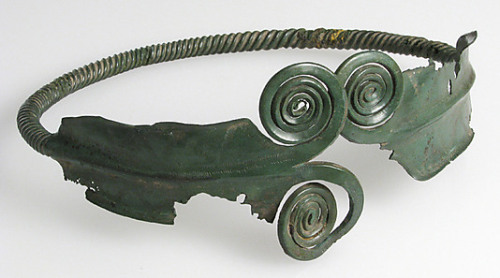
This beautiful copper alloy diadem was created in what archaeologists call the Hallstatt Culture, a European Iron Age culture. It was made circa 750–500 BCE. The Metropolitan Museum of Art in New York, which owns the diadem, isn’t clear about precisely where it was discovered, but it’s from the Carpathian region.
(Source.)
What is history's role in society?
History. Any society that doesn’t pay proper attention to it not only has dangerously shallow roots, but also risks starving its own imagination.
lucidrake: Can anyone tell me anything about this? I’ll define...

front view

side

other side

The hole

the back
Can anyone tell me anything about this? I’ll define it a little bit from what you can and cannot see from the photos.
It’s light in weight. light barely passes through it like a clouded crystal. it has a very rough texture equivalent to a fine sandpaper. the “back” is concave. light does not readily reflect off its surface but you can scratch the surface with your fingernail to reveal a shininess in the light. the hole is an absolute perfect circle and there is a line in the absolute middle of the hole that goes around the cavity as if it were some kind of seem line left over from a machine or… something. branching off this tiny bump of line, there are these little dark cracks on a smoother surface. the cracks resemble the lines of leaves. when i drop it, it does not make quite the same sound as a crystal or a rock. I discovered it in the Uwharrie National Park in North Carolina just off a main trail, covered in mud and dirt.
Help please?
HEY THERE FOLLOWERS, CAN WE HELP? WHO CAN SHED SOME LIGHT? NOW I AM ALSO INTRIGUED.
"It needs to be repeatedly emphasized that no explanation of Upper Palaeolithic art can ever be..."
- David Lewis-Williams, The Mind in the Cave (via nrmoore)
history-and-mystery: Sandal Castle 1 by meerstone on...

Sandal Castle 1 by meerstone on Flickr.
The construction of Sandal Castle was begun around 1110 in the reign of Henry I as a motte-and-bailey castle. This first wooden castle was rebuilt in stone in the 1180s.
By the time of the English Civil War in the 17th century the castle was in a state of disrepair. It was largely destroyed during a siege in 1645 and was further dismantled a year later on the orders of parliament. It is now a park
The Arched Metatarsal of Australopithecus Afarensis

Carol Ward1, William Kimbel, and Donald Johanson have published a paper in Science on the arch seen in a newly discovered fourth metatarsal ofAustralopithecus afarensis (AL 333-160). A lot of the popular press are publishing misleading headlines that this proves bipedalism in australopithecines. No, we’ve known they were bipedal — we just didn’t have a true idea as to what extent they were bipedal. So a find like this helps investigate the degree of bipedalism.
A Hot Cup of Joe
Archaeological News: Tomb Near Serres Wife, Son of Alexander?
Αrchaeologists from the 28th Ephorate of Antiquities unearthed a tomb in the city of Amphipolis, near Serres, northern Greece, which they believe could belong to the wife and son of Alexander the Great, Roxane and Alexander IV.
The circular precinct is three meters, or nearly 10 feet high and its perimeter is about 500 meters or 1,640 feet surrounding the tomb located in an urban area close to the small city of Amphipolis. The head of the team, Katerina Peristeri noted that it is too soon to talk with certainty about the identities of the discovery.
“Of course this precinct is one we have never seen before, neither in Vergina nor anywhere else in Greece. There is no doubt about this. However, any further associations with historic figures or presumptions cannot be yet made because of the severe lack of evidence and finances that will not allow to continue the excavations at least for the time being,” she added.
betweensilenceandthesea: THIS MIGHT BE THE FIRST MEME I’VE EVER MADE. maybe. I don’t remember. I...
THIS MIGHT BE THE FIRST MEME I’VE EVER MADE. maybe. I don’t remember. I was a Classics major so sue me.
culturalsecurity: Turkey Battles the Met over Restitution...

Turkey Battles the Met over Restitution Claims
The Metropolitan Museum of Art in New York, like most institutions of its size in the US and Europe, has seen its fair share of lawsuits and controversies surrounding its collection. It returned nearly two dozen antiquities to Italy in 2006, as well as work acquired via Nazi looting.
But now the Met is facing a very different kind of restitution battle. The Turkish government is insisting it is the rightful owner of 18 objects from the collection of Norbert Schimmel, a Met trustee and one of the last century’s most astute collectors of Mediterranean antiquities.
Unlike the Italian claim, and unlike in the cases of Holocaust victims’ families, the proof here is scant to nonexistent. What’s more, both the US and Turkey are signatories to a Unesco convention stating that if a cultural object left the country in which it was produced before the year 1970, then it’s free to circulate. That cutoff date puts almost all the Met’s antiquities in the clear.
But Turkey doesn’t care, it now seems: it’s citing its own law, more than a century old, to insist that the artifacts belong to it.