He calls himself: a politically-progressive, ethically-herbivorous anthropoid pursuing a paleontology education in the Los Angeles Basin.
Interview With a Vegan Paleontologist: “The Humane Hominid”
Taliban Demands Unbiased Coverage of Its Attempted Murder of a 14-Year-Old Girl
Pakistan’s Taliban insurgency faces a spate of bad press in mainstream Pakistani outlets related to the jihadists’ failed assassination attempt of Malala Yousafzai, a young blogger who dared protest the Taliban’s ban on educating girls. Now the Taliban are plotting terror strikes on TV stations and other media organizations, but local newspapers refuse to stay silent.
The first report of these plots were surfaced by an urdu-language reporter on Saturday, who uncovered a special directive by the chief of the banned Tahreek-i-Taliban Pakistan (TTP) Hakimullah Mehsud. As local newspaper Dawn reported, “Mehsud directed his subordinate to target the offices of media organisations in Karachi, Lahore, Rawalpindi, Islamabad and in other cities of the country especially those media organisations and media personalities who were denouncing TTP after attack on child activist Malala Yousufzai.” In response, the Interior Ministry has beefed up security near media organizations. But the Taliban are still whining.
Ancient "Predator X" sea monster gets official name
It’s official: A giant, marine reptile that roamed the seas roughly 150 million years ago is a new species, researchers say. The animal, now named Pliosaurus funkei,spanned about 40 feet and had a massive 6.5-foot-long skull with a bite four times as powerful as Tyrannosaurus rex.
“They were the top predators of the sea,” said study co-author Patrick Druckenmiller, a paleontologist at the University of Alaska Museum. “They had teeth that would have made a T. rex whimper.”
Combined with other fossil finds, the newly discovered behemoth skeletons of P. funkei paint a picture of an ancient Jurassic-era ocean filled with giant predators.
In 2006, scientists unearthed two massive pliosaur skeletons in Svalbard, Norway, a string of islands halfway between Europe and the North Pole. The giant creatures, one of which was dubbed Predator X at the time, looked slightly different from other pliosaurs discovered in England and France over the last century and a half. [See Images of Predator X]
Now, after years of painstaking analysis of the jaw, vertebrae and forelimbs, the researchers have determined that Predator X is in fact a new species, and they have officially named it for Bjorn and May-Liss Funke, volunteers who first discovered the fossils.
Click through to read more….
ROMKids: National Archaeology Day at the ROM!
Why not escape the Toronto rain this Saturday and come to the ROM to hear about hot and sunny countries? Saturday is National Archaeology Day at the ROM, and we’ve been hard at work sorting out lots of events, talks and activities (for kids AND grown ups). I don’t have any good behind-the-scenes photos because no one has stood still for long enough! Things have been hectic with deciding on activities, inviting speakers, co-ordinating volunteers, ordering equipment, creating fact sheets and advertising the event. Massive thanks to lots of ROM staff, professors and students from the U of T, and the Toronto branch of the AIA for their hard work so far. Keep it up!
National Archaeology Day is a big deal (at least I think it is). It’s an annual event that is happening across North America and beyond (more than 100 institutions are taking part), promoted by the Archaeological Institute of America, one of the largest archaeological organisations in the world. What’s so important is that it’s trying to make sure everyone understands what archaeology is, why it matters and why it needs support – difficult when there are so many other good causes to worry about.
Junior archaeologists hard at work at being the next Justin Jennings.
Come and meet real live archaeologists! In Currelly Gallery students will be talking about excavations they’ve worked on in Turkey, Syria, Crete and Peru, and the ROM’s very own Justin Jennings will be talking about his work in Peru in the lecture theatre. They don’t all look like Indiana Jones (just warning you), but they do have some good stories – some of them even get into the news (see the Toronto Star here and here). Unlike Indiana Jones, proper archaeologists don’t just uncover ‘treasure’ to take home. Systematic excavation and recording is as important as even the most spectacular finds, because that’s what really helps us understand the past. Kids (and kids at heart) will also be able to have a go at learning excavation and fieldwork techniques.
Me ‘hard at work’ in a sunny country (archaeological site of Perachora, Greece).
But archaeology is about more than just digging up dirt (and ‘treasure’) in hot countries (some of you may have seen my opinions on this in an earlier blog. It’s also about preserving, studying and understanding the discoveries made during excavations, to help explain the past. So there will also be activities and talks from the people who conserve and study artefacts, and display them to everyone else. As well as talking to conservators, curators and academics about how objects were made and restored, you can repair your own broken pot, and make your own ‘ancient objects’, such as an Egyptian collar, and a Minoan headdress up in the Currelly Gallery. Two ancient world experts from out of town, Derek Counts and Carol Mattusch, will be talking about their subjects in the lecture theatre, and the series of lecture theatre talks will be kicked off by ROM curator and U of T professor Clemens Reichel talking about the up-coming Mesopotamia exhibition. Come along at 11.30 to hear some behind-the-scenes stories which will make you think about what went into the next exhibition you walk through!
Clemens at last year’s Archaeology Weekend!And finally, because dressing up seems to be a key to the most successful ROM events, we have re-enactors, to show us how living history can help us understand the past. Because it’s that year we will be exploring the war of 1812 with Dr Dunnfore, a field doctor, and some 1812 soldiers. They show that archaeology isn’t just about very old things, but also about more recent history.
So come along, escape the rain and have fun while supporting a good cause – the promotion of archaeology. Spread the word!
This post was written by Kate Cooper. Kate is awesome, and is one of my favourite archaeologists at the ROM. She’s also British and uses words like “proper” in sentences. It’s like talking with someone from Harry Potter.
National Archaeology Day!
This Saturday, enjoy a museum, your local historical society, etc. Because this Saturday, October 20, 2012 is National Archaeology Day!
laphamsquarterly: Lincoln / Johnson ‘64...

Lincoln / Johnson ‘64 baby!
(via Abe Lincoln’s Ultraslick, Obama-like Social Media Campaign - Technology - The Atlantic)
victusinveritas: yourmaj3sty: Ancient Astronaut...

Ancient Astronaut Relic..
Ancient astronaut relic my ass, this is clearly an ancient relic of that awesome drilling machine from Teenage Mutant Ninja Turtles…or one of those other Saturday morning cartoons that features tunneling hi-jinx. Turn it so that it is standing on it’s tip it also looks like a dude hanging out in a partially eaten carrot…which I’m sure you’ll agree is evidence of…
ancient hyper-intelligent rabbits being worshiped as gods…which explains a lot of the impulse (quite wabbit like) to bury treasure and other things (bodies) underground…like the Earth is really just a warren writ large…and caves are just…the entryways…
WHOA…
Option 3: It’s a dildo. Cover that shit in some coconut oil and lard and it’ll smooth that stony roughness right out, and then it’s a hot time in the old town tonight!
moderation: Bright Particle of Martian Origin in Scoop...

Bright Particle of Martian Origin in Scoop Hole
This image contributed to an interpretation by NASA’s Mars rover Curiosity science team that some of the bright particles on the ground near the rover are native Martian material. Other light-toned material nearby (see PIA16230) has been assessed as small debris from the spacecraft.
Curiosity’s Mars Hand Lens Imager (MAHLI) camera took this image on the mission’s 66th Martian day, or sol, (Oct. 12, 2012) showing part of the hole or bite left in the ground when Curiosity collected its first scoop of Martian soil five sols earlier. A clod of soil near the top center of the image contains a light-toned particle. The observation that the particle is embedded in the clod led scientists to assess this particle as Martian material, not something from the spacecraft. This assessment prompted the mission to continue scooping in the area, despite observations of a few light-toned particles in the area being scooped.
The image shows an area about 2 inches (5 centimeters) across. It is brightened to improve visibility in the shaded area.
Image Credit: NASA/JPL-Caltech/MSSS(via NASA)
allmesopotamia: From an Assyrian relief at the Louvre
turtlecub96: I am a paleontologist. I am an archaeologist but...
gunhilde: Excavating at Hornby Castle today and tomorrow. I am...


Excavating at Hornby Castle today and tomorrow. I am unreasonably excited about kneeling in the mud digging things up.
For the record, the excavation isn’t actually right by the castle itself, as pictured. It is on the castle grounds, at the site of a medieval guest house (and possible earlier high-status site). Most of what we found today was medieval and post-medieval pottery, some of which you can see in the stray finds tray here.
"Love is fleeting. Hand axes are forever."
mertseger: Pre-Dynastic Egypt. Naqada II, c. 3900 - 3300 BCE
archaicwonder: Marsyas by ozanhatipoglu on Flickr. In Greek...

Marsyas by ozanhatipoglu on Flickr.
In Greek mythology, the satyr Marsyas (Μαρσύας) is a central figure in two stories involving death: in one, he picked up the double flute (aulos) that had been abandoned by Athena and played it. In the other, he challenged Apollo to a contest of music and lost his hide and life.
In Antiquity, literary sources often emphasize the hubris of Marsyas and the justice of his punishment.
Prehistoric Autopsy - Alice Roberts
In the first episode of Prehistoric Autopsy, Professor Alice Roberts, Dr George McGavin and a team of leading anatomists, anthropologists, archaeologists and SFX gurus will bring BBC Two viewers face to face with one of our closest human ancestors – a Neanderthal. Using the latest scientific research, the team will reconstruct one particular Neanderthal from the bones up.
Paleoartist Viktor Deak and a team of model makers will reconstruct an entire body and provide a unique insight into how Neanderthals looked, lived and how they compared to us today. Prehistoric Autopsy will explore how 21st-century technology is shining a light on one of the reasons why Neanderthals may have died out and we survived; how the bones of prehistoric animals are revealing clues about how successful Neanderthals were at hunting; and how archaeologists have been uncovering evidence of cannibalism in the species when it was on the verge of extinction.
Prehistoric Autopsy starts monday 22nd on BBC2 at 9pm and runs for 3 episodes, concluding on wednesday the 24th
Evidence of Viking Outpost Found in Canada
Sharpeners may be smoking guns in quest for New World’s second Viking site.

Archaeologist Patricia Sutherland (orange jacket) excavates a potential Viking site on Baffin Island.
For the past 50 years—since the discovery of a thousand-year-oldViking way station inNewfoundland—archaeologists and amateur historians have combed North America’s east coast searching for traces of Viking visitors.
It has been a long, fruitless quest, littered with bizarre claims and embarrassing failures. But at a conference in Canada earlier this month, archaeologist Patricia Sutherland announced new evidence that points strongly to the discovery of the second Viking outpost ever discovered in the Americas.
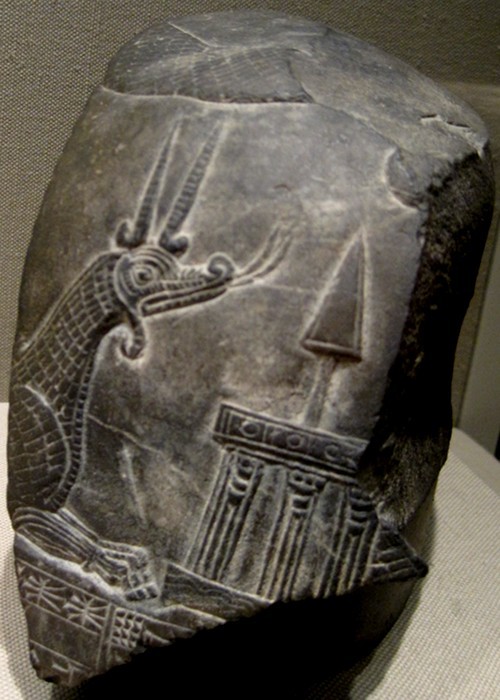
tammuz: Mushussu (also known as Mushhushshu or Sirrush) is the...

Mushussu (also known as Mushhushshu or Sirrush) is the Dragon of Babylon and one of two animals depicted on the Ishtar Gate. It is depicted here on a kudurru (boundary stone) with divine symbols. This limestone kudurru dates back to the Second Dynasty of Isin, 1156-1025 BCE.
Newly unearthed artifacts depicting the Mushussu or Mushhushshu that were kept in Babylon Museum in Iraq were stolen in mid October 2012. The Metropolitan Museum of Art, New York City, NY.
Photo by Babylon Chronicle
Archaeological News: Morocco denies destruction of ancient carvings
Yagour, Morocco - Morocco’s government has denied claims that Salafists had destroyed stone carvings dating back more than 8,000 years in the High Atlas mountains.
“The reports that these stone carvings were damaged, as you can see, is not true,” Communications Minister Mustapha Khalfi told journalists, on a government organised trip to the Yagour plateau.
“It is one of our goals to protect these pre-historic monuments, which reflect Morocco’s cultural diversity and the deepness of our history,” Khalfi told AFP.
More than a dozen undamaged carvings of the sun, depicted as a divinity, were visible on rocks located in the middle of the valley south of Marrakesh, about 20 kilometres from Mount Toubkal, Morocco’s highest peak.
gunhilde: Things I found today: - pottery: some medieval, plus...


Things I found today:
- pottery: some medieval, plus one very nice large sherd of a Civil War period tin-glazed plate
- animal bone fragments and one deer tooth
- charcoal
- slag
- a lot of mortar
- an one large marble chip, possibly used as a gaming or counting piece
Photo