Detail from the sculpture Dying Gaul, Roman marble copy of a Hellenistic work of the late third century BCE.
Courtesy Jastrow and the Capitoline Museums, Rome.
Detail from the sculpture Dying Gaul, Roman marble copy of a Hellenistic work of the late third century BCE.
Courtesy Jastrow and the Capitoline Museums, Rome.
Rocks carved into ancient stone arrowheads or into lethal tools for hurling spears suggest humans innovated relatively advanced weapons much earlier than thought, researchers in South Africa say.
The researchers’ finds, partially exposed by a coastal storm, suggest ancient peoples were capable of complex forms of thinking, scientists added.
“These people were like you and I,” researcher Curtis Marean, a paleoanthropologist at Arizona State University in Tempe, told LiveScience.
Modern humans originated in Africa about 200,000 years ago, but when modern human ways of thinking emerged remains controversial. For instance, some researchers note that the first signs of complex thought such as art appeared relatively late in history, suggesting that genetic mutations linked with modern human behavior occurred as recently as 40,000 years ago. Other scientists argue that modern human thought originated much earlier but that the evidence was largely lost to the rigors of time.
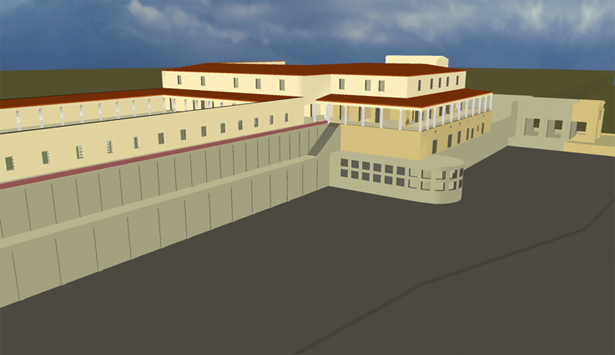
A Virtual Model of the Villa dei Papiri by M. Zarmakoupi
The model presents a digital walkthrough of the grand ancient villa, which was located by the sea and decorated throughout with mosaics and frescoes. Named after the collection of papyrus scrolls found on its premises, the Villa dei Papiri is famous for inspiring the design for the Getty Villa, though the Getty Villa’s groundplan is adapted to its narrow canyon site.
The VR model incorporates data from both past and recent excavations and proposes a scientifically documented reconstruction, as opposed to commercial reconstructions that are influenced by the Getty Villa. I developed the model in discussion with the excavators of the site with the purpose of making it available as a research tool for archaeological excavation. The Villa dei Papiri is located below ground level under layers of rock, and still has not been entirely excavated.
My aim in creating the virtual-reality model of the Villa of the Papyri was threefold. First, I set out to create a digital architectural model that incorporates the architectural structures known from the 18th century as well as those found in recent excavations. Second, I wanted to present a reconstruction that distinguishes the structures known from Karl Weber’s groundplan made in 1758, when the villa still lay mostly underground, from the structures that have been unearthed in excavations conducted between 1986 and 1998, and again since 1999, as well as from proposed restorations. These areas are color-coded on the model: beige for areas known from the 18th century plan, gold for areas revealed during the recent excavations, and grey for reconstructed areas.
Terracotta oinochoe: chous (jug)
Attributed to the Meidias Painter
Classical Greek
c. 420-410 BCE
Height: 21.4 cm
Women perfuming clothes
The scene depicts two women in festive dress perfuming garments. A stool suspended by chords is piled with folded clothing. On the ground below, there is a pile of wood shavings and twigs from which smoke rises. One woman carefully empties an oinochoe onto the fire. The other woman surveys the “swing” and stands beside a stately chair with a footstool over which more clothes are slung. At the far left is a wreathed boy wearing a himation (cloak). The shape of the vase facilitates the association of the scene with the Anthesteria, a three-day festival held in January/February that celebrated the new wine with the special inclusion of young children, an epiphany of Dionysos, and the ritual marriage of the god with the basilinna, the wife of the chief archon of Athens.Source: Metropolitan Museum
The Egyptians, who were the authors of the mysteries and mythical representation, did not ignorantly literalize mythical characters, and had no “Fall of Man” to encounter; as Christianity does. Consequently, they had no need of a Redeemer from the effects of that which had never occurred. They did not rejoice over the death of their suffering Savior, because his agony, shame, and bloody sweat were falsely supposed to rescue them from the consequence of broken laws. On the contrary, they thought that everyone created his own Karma here, and that the past deeds made the future fate.
Horus did things for the glory of his Father, and not to save the souls of men from having to do them. There was no vicarious SALvation or imputed righteousness. He did not come to save sinners. Horus was a model of divine worship, but his followers must conform to his example and do in life what he had done, before they could claim any fellowship with him in death. ”Except ye do these things yourselves, there is no passage, no opening of the gate to the land of life everlasting”.
“What meant the giving of the crucifix, of the garlic, of the wild rose, of the mountain ash? Bless that good, good woman who hung the crucifix round my neck! for it is a comfort and a strength to me whenever I touch it.”Dracula by Bram Stoker
A rosary from Ethopia.
Bulgarian Archaeologists Find Unique Gold Thracian Treasure
Bulgarian archaeologists have found a unique gold Thracian treasure in the famous Sveshtari tomb.
The team, led by one of the most prominent Bulgarian experts on Thracian archaeology, Prof. Diana Gergova, from the National Archaeology Institute at the Bulgarian Academy of Sciences, BAS, made the discovery during excavations at the so-called Omurtag mount.
The researchers found fragments of a wooden box, containing charred bones and ashes, along with a number of extremely well-preserved golden objects, dated from the end of the 4th and the beginning of the 3rd century B. C.. They include four spiral gold bracelets, and a number of intricate applications like one which shows the head of a female goddess adorned with beads, applications on horse riding gear and a forehead covering in the shape of a horse head with a base shaped like a lion head. The objects weigh 1.5 kg, but the excavations continue.
The precious find also contains a ring, buttons and beads. Gergova explains that it seemed the treasure was wrapped in a gold-woven cloth because a number of gold threads were discovered nearby.
The Professor says these were, most likely, remnants from a ritual burial, adding the team expects to discover a huge burial ground, probably related to the funeral of the Gath ruler Kotela, one of the father-in-laws of Philip II of Macedon. She notes this is a unique find, never before discovered in Bulgaria.
Archaeologists are facing a possible murder mystery after discovering two 8,500-year-old human skeletons at the bottom of a rare Stone-Age well used by the first farmers in Israel’s Jezreel Valley.
The skeletal remains belonged to a woman aged about 19 and an older man, according to archaeologists who announced the discovery today in an e-mailed release. The well dates back to the Neolithic period, they said.
“How did they come to be in the well?” the Israel Antiquities Authority asked in the statement. “Was this an accident or perhaps a murder? As of now, the answer to this question remains a mystery.”
Image: Brent Huffman
Documentary filmmakerBrent Huffman has put together a campaign in an attempt to save the Mes Aynak Buddhist archaeological site from destruction.
The campaign, which you can contribute to through Kickstart, has attracted over 50,000 supporters in just…
The site occupies land which has been earmarked for destruction in December 2012 when a Chinese company will turn the site into a copper mine.
You can read more about the site, the project and Huffman’s efforts on the Past Horizon’s website - although it made the front page of Reddit and is battling with the traffic!
A rare, near-complete mammoth skeleton has been unearthed near Paris
“You know what’s rare? Woolly mammoth skeletons. You know what’s even rarer? Beautifully preserved, near-complete, French woolly mammoth skeletons. Archaeologists just dug up the latter.
Dubbed “Helmut” by the archaeologists who discovered it, the specimen was encountered accidentally during an unrelated excavation at the Changis-sur-Marne riverbank, about 30 miles northeast of Paris. According to the Associated Press, it’s only the third mammoth to be discovered in France in the last 150 years.”
Vampire Skeleton Rediscovered in Britain
Details of one of the few “vampire” burials in Britain have emerged as a new archaeological report details the long forgotten discovery of a skeleton found buried with metal spikes through shoulders, heart area and ankles.
Dating from 550-700 A.D., the skeleton was unearthed in 1959 in the minster town of Southwell, Nottinghamshire, during excavations in preparation for a new school. The dig also turned up Roman remains.
Archaeologist Charles Daniels immediately recognized the skeletal remains as being out of the ordinary, but no further investigation was carried out at that time.
“Daniels did jokingly comment he had ‘checked the eye teeth,’ clearly associating the skeleton with the vampire being,” Matthew Beresford, of Southwell Archaeology told Discovery News.
Israeli paleographer Ada Yardeni has recently identified 50 Dead Sea scrolls found near Qumran in Israel as having been penned by the same scribe, a scribe who also penned scrolls that have been found at the Herodian mountain-top fortress of Masada, where Jewish rebel zealots made their last suicidal stand against the Romans in 73 A.D.
The subject scrolls were previously discovered in six different caves in the area of the Qumran site. In an article authored by Sidnie White Crawford and published in the November/December 2012 issue of Biblical Archaeology Review, Crawford writes that documents penned by the same scribe and found in multiple caves implies that “the scribe was a member of that sect who also copied Jewish scriptural scrolls, countering the idea that the Qumran collection was a non-sectarian ‘general Jewish’ library.”
The first book on the history and culture of the people for whom Missouri is named has been published. Arrow Rock State Historic Site Administrator Michael Dickey has written The People of the River’s Mouth: In Search of the Missouria Indians.
A program on his book will be presented Thursday at 7 p.m. at the Missouri State Archives in Jefferson City.
Dickey says it was about time someone compiled the information that exists on the Missouria.
“I just felt like … here is the longest river in the United States and the twenty-fourth state named after people, and nobody knows hardly anything about them. In fact, most Missourians didn’t even know that the river and the state was named for a specific Indian tribe.”
Many people know “Missouria” as meaning “One who has Dugout Canoes,” but Dickey takes the book’s name from what the people we know as the Missouria called themselves. “In their language, they call themselves Niutachi, which means, ‘People of the River Mouth.”
Pair of Gold Armbands from Chavin Culture, Peru
7th-5th century BCE
Height: c.4.7 cm & Length: 20.3 cm
Source: Metropolitan Museum
Classic Maya civilization rose and fell with the rains.
This once-majestic society, known for massive pyramids and hieroglyphic writing, expanded during an unusually rainy time and declined as the sky’s spigots dried up and periodic droughts arrived, a new study suggests.
A 2,000-year climate record, gleaned from a stalagmite inside a Belize cave, highlights a central role for climate shifts in the ancient civilization’s fortunes, say anthropologist Douglas Kennett of Penn State University and his colleagues.
A bounty of rain nurtured Maya agriculture and city building from the years 440 to 660, Kennett’s team reports in the Nov. 9 Science. A drying trend and occasional droughts after 660 were accompanied by declining crop yields, increasing warfare among Maya city-states and a shift of political centers northward into the Yucatan Peninsula, the researchers say.
A human face stares from these remnants of Lapita pottery, dated 1000 BC. They come from the Santa Cruz group of islands, south-east of the Solomon Islands. Around 3000 BC ceramic-making peoples appeared in Taiwan. Taiwanese pottery was red-slipped but otherwise plain. Over the next 1,500 years their descendants moved south and south-east towards Near Oceania. In the Bismarck Archipelago these Austronesian peoples mixed with the indigenous inhabitants and the Lapita culture, with its distinctive pottery, emerged. Lapita pottery had surface decorations; these motifs probably already existed in tattoos.
Who doesn’t love the idea of discovering sunken treasure? I’m sure I remember it being a dream of mine as a young boy. Sailing off a ship (pirate or otherwise), following a map to find the spot where x marks, and then opening up those chests full of gold. “Ah ha me maties, we’ll share this bullion and have a few rums to celebrate.” Or something like that. I’m not sure about the rum part of things – I was just a kid, after all.
Well, finally my dream came true in Turkey when I found the spot, I found x, I found sunken treasure. True, archaeologists and professional divers had already retrieved everything from the water and put it all in one location, but it was still worthy of some celebrational rum later that evening.
This is the website of travel writer, Michael Turtle. After working in broadcast journalism for a decade in Australia, Michael left Sydney to travel the world indefinitely and write about the places, people and experiences he discovers. This isn’t a diary - these are real stories from the world.