↧
yourmaj3sty: Ancient Babylonian World Map


↧
ancientpeoples: The Athenian Acropolis: An Overview The...


The Athenian Acropolis: An Overview
The Acropolis was the citadel of ancient Athens. It was used as a refuge in difficult times and served as the city’s principal sanctuary in Greek and Roman times. It is an outcrop of hard limestone, raising steeply out of the surrounding plain to a height of around 150 meters above sea level. It could only be approach easily from the west therefore it was a strategic defensive point, something that probably attracted people to settle around it.
The fortunes of Athens over the centuries can often be read in the degree of accessibility to the Acropolis: broad ramps and large gateways in times of peace, additional walls, winding paths, bastions, towers and smaller doorways in times of trouble.
The area on the top, fortified from the Bronze Age to the 19th century, measures about 110 meters north to south by 250 meters east to west. In the Late Bronze Age a palace would have stood on the summit comparable to those that existed at Mycenae, Tiryns and Pylos.
In the historical period the Acropolis was sacred to the goddess Athena and served as her cult centre. Large Doric temples were built in her honour in the 6th century BC, at this time a number of marble votive statues were erected to the goddess and several small doric “treasuries”, or small buildings, made of limestone were constructed. All these were swept away when the Persians burned the Acropolis in 480/79 BC.
The shattered fragments the remained were left standing and when the area was finally cleared for new buildings, the archaic remains were carefully buried. It is for this reason that, in general, the Archaic material survives better than its classical counterparts as it hasn’t suffered the ill effects of prolonged exposure and gradual disintegration. Much of this older Archaic material still preserves some of it’s original paint decoration.
In the fifth century the Acropolis became a focal point of the Periclean building program to replace the temples destroyed by the Persian. Under the famous Pheidias, an army of architects, sculptors, masons, painters, and artisans built the Parthenon, the Propylaia, the temple of Athena Nike, and the Erechtheion.
These great achievements of architecture can still be seen today (though many have received several programs of restorations). A few of the “lesser” monuments on the Acropolis have not faired so well and don’t survive above the lowest courses. In the south west corner there was a sanctuary of Artemis Brauronia, and just east of that the Chalkotheke (a large storeroom for bronze dedications and weapons).
Dozens of statues were dedicated out in the open, many of which survived to the Roman period and are described in detail by Pausanias.
The lower slope of the Acropolis was ringed by an ancient path known as the peripatos. Above this, the terrain was covered with sanctuaries practically all the way around. The sanctuaries on the north slope are generally less substantial architecturally than those on the south, instead they were often confined to caves and open areas in front of scarps where niches were carved into the stone. Worshippers honoured figures such as Pan, the Nymphs, Apollo, Aphrodite, Eros and Agalauros to name a few.
A portion of the north west slopes were enclosed by an early circuit wall known as the Pelargikon. Within this was the Klepsydra spring which offered an important source of water from the late Neolithic times until the 19th century.
More substantial sanctuaries occupied the sunny southern slopes. Here there was a sanctuary to Dionysos, with temples, stoa, odeion and a huge theater. It was in this theater that the great plays of Athenian drama were performed. Also on this slope was the Asklepieon, the Athenian sanctuary to the healing god Asklepios, which had a temple, fountain, altar and stoas. Also worshipped in this area were the deities Hermes, Aphrodite, Pan and the Nymphs. Also the Egyptian goddess Isis was worshipped here as well as Themis and Nymphe.
King Eumenes of Pergamon built a huge stoa in the 2nd century BC on the southern slope to provide shelter for the thousands attending the theater. Another post classical development here was a lavish odeion funded by a local philanthropist Herodes Atticus built around 160 AD. Below this in late Roman times the south west slope was covered with large private houses.
↧
↧
lenofi: mysticplaces: Jarlshof archaeological site | Shetland,...
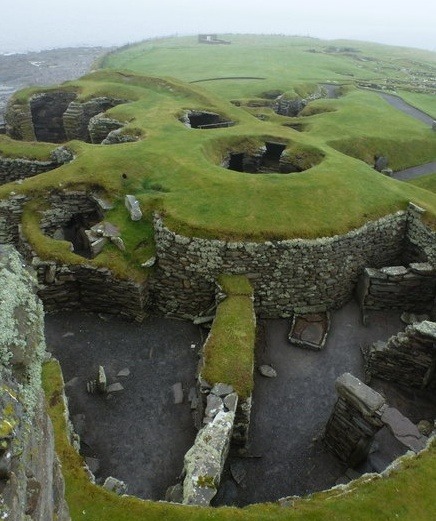


Jarlshof archaeological site | Shetland, Scotland
Super cool site with multi-period use (which is my favorite thing in archaeology)…for more info check this out from the Royal Commission on the Ancient and Historical Monuments of Scotland. It includes evidence of Neolithic, Bronze Age, Iron Age, Norse, Late Medieval, and Post-Medieval occupation.
↧
Archaeologists banned from calling hominid group "Hobbits"
Because of their diminutive size, scientists and laypeople alike have gotten into the habit of referring to the ancient hominids Homo floresiensis as “Hobbits”. The hominids stood about 3 and a half feet tall, making them perfect hobbit size. But now the company that owns the film right to “The Hobbit” has demanded scientists stop calling them hobbits. Hobbits.

↧
Stone labyrinths of Bolshoi Zayatsky Island (Solovki)

↧
↧
'Murder' body found at Hadrian's Wall was from overseas
'Murder' body found at Hadrian's Wall was from overseas :
A child who was possibly murdered at one of Britain’s most important Roman sites 1,800 years ago came from the Mediterranean, an expert said today.
The discovery implies the young victim was either a child slave or the son or daughter of a soldier serving on Hadrian’s Wall - giving more weight to the theory that they brought their families with them to the wilds of Northumberland.
↧
Excavations Uncover Common Life in Ancient Petra
Excavations Uncover Common Life in Ancient Petra:
The word “Petra” brings to mind images of the elaborately sculpted rock-cut temples and tombs that characterize this much-visited site in southeastern Jordan, a site that has been voted one of the “Seven Wonders of the Modern World”.
But like most ancient monumental centers revealed by the careful work and research of archaeologists and conservationists, what meets the eye at Petra is only part of the picture. It represents an ancient populace that constituted the elite minority. The rest of its forgotten inhabitants remain shrouded in comparative mystery. They have been overlooked.

↧
poudanger: Extraordinary Roman mosaics such as this image of a...

Extraordinary Roman mosaics such as this image of a girl or perhaps a goddess once decorated wealthy houses in Zeugma in southern Turkey.
↧
Archaeological News: Ancient Roman Giant Found—Oldest Complete Skeleton With Gigantism
Archaeological News: Ancient Roman Giant Found—Oldest Complete Skeleton With Gigantism:
It’s no tall tale—the first complete ancient skeleton of a person with gigantism has been discovered near Rome, a new study says.
At 6 feet, 8 inches (202 centimeters) tall, the man would have been a giant in third-century A.D. Rome, where men averaged about 5 and a half feet (167 centimeters) tall. By contrast, today’s tallest man measures 8 feet, 3 inches (251 centimeters).
Finding such skeletons is rare, because gigantism itself is extremely rare, today affecting about three people in a million worldwide. The condition begins in childhood, when a malfunctioning pituitary gland causes abnormally growth.
Two partial skeletons, one from Poland and another from Egypt, have previously been identified as “probable” cases of gigantism, but the Roman specimen is the first clear case from the ancient past, study leader Simona Minozzi, a paleopathologist at Italy’s University of Pisa, said by email.

↧
↧
'Iceman' Was Central Europe Native, New Research Finds
'Iceman' Was Central Europe Native, New Research Finds:

SAN FRANCISCO — Otzi the Iceman, an astonishingly well-preserved Neolithic mummy found in the Italian Alps in 1991, was a native of Central Europe, not a first-generation émigré from Sardinia, new research shows. And genetically, he looked a lot like other Stone Age farmers throughout Europe.
The new findings, reported Thursday here at the American Society of Human Genetics conference, support the theory that farmers, and not just the technology of farming, spread during prehistoric times from the Middle East all the way to Finland.
“The idea is that the spread of farming and agriculture, right now we have good evidence that it was also associated with a movement of people and not only technology,” said study co-author Martin Sikora, a geneticist at Stanford University.
↧
"Island of the Blue Dolphins" setting found
"Island of the Blue Dolphins" setting found:
After years of searching tiny San Nicolas Island off the coast of Los Angeles, a group of archaeologists believe they have found the cave inhabited by the woman who was the inspiration for the popular young adult novel The Island of the Blue Dolphins. The cave escaped detection by earlier searches because it had been filled in by tons of wind-blown sand.
The novel expands on the tale of the “Lone Woman of San Nicolas” who survived alone on the small, scrubby island for 18 years after the rest of the inhabitants left for the mainland in 1835.
(Source: Los Angeles Times)
↧
culturalsecurity: I Predatori dell’Arte at Villa Giulia The...

I Predatori dell’Arte at Villa Giulia
The National Etruscan Museum at Villa Giulia is displaying several hundred antiquities from among the thousands illegally exported and now repatriated to Italy. They are mainly from central and southern Italy and are part of an exhibition that documents a decade-long criminal investigation and legal battle to obtain pieces that were sold abroad after clandestine excavations all over Italy.
Alongside display cases of repatriated Etruscan artefacts from Cerveteri and Vulci are descriptions of the methods of trafficking and laundering antiquities such as Polaroid photographs of broken and reassembled pieces inside tombs, receipts from auction houses and an art dealer’s journal. The antiques were usually exported to Switzerland and stored in a bonded warehouse in Geneva, before being re-sold to museums and private collectors all over the world. Read moreFor similar news stories visit http://culturalsecurity.net/newssummary.htm
↧
dionysius: The Archaeology News Network is a non-profit daily updated online newspaper featuring...
The Archaeology News Network is a non-profit daily updated online newspaper featuring all the latest stories and headlines relating primarily to Archaeology, Anthropology and Palaeontology published on the World Wide Web.
↧
↧
border-studies: Intriguing review of the new book “What is...

Intriguing review of the new book “What is Media Archaeology?”Near the beginning of What is Media Archaeology?, the author notes that the resilience of vinyl records, 8-bit games and Sony Walkmans as ‘zombie media’ correlates with the childhood preferences of a generation that is now hitting early-middle age. This is surely correct. Nintendo and Sega have become a new generation’s rocking horses and train sets. Without wanting to be too reductive, you can’t help but notice that media archaeology, as practiced here, is a mode of critical analysis historiographical essay plus that brings together many of the formative cultural building blocks of the Generation X demographic. Parikka drops names with the same rapidity that 1990s rappers namechecked brands. (And there’s often reason to be grateful for this: What is Media Archaeology? opened up several new literatures for me.) Alongside the sophisticated middle-class consumer preferences and jaundiced post-Cold War politics sit references to all the popular cultural theories imbibed by the part of that generation that stayed on at university to get PhDs. In this sense, much of What is Media Archaeology? seems peculiarly familiar and second hand, even as it stakes out ostensibly new territory. A valid, albeit narrow way, to understand the book’s argument is as the intellectual conspicuous consumption of a Western educated scholar of thirty-to-forty something vintage. As Kittler himself attempted to historicise how the theories of thinkers like Freud and Lacan were shaped by changes in media technology, it doesn’t seem wrong to subject Parikka, a lecturer/practitioner at Winchester School of Art, to similar treatment. ‘Media are not pseudopods for extending the human body’, wrote Kittler, ‘they follow the logic of escalation that leaves us and written history behind it’. This is a sentiment that the generation which grew up hiding behind the sofa from Skynet’s cyborg agents can instinctively share.
↧
allmesopotamia: Artist’s rendition of the ancient city of...

↧
history-and-shit: Depiction of the first kings of the Lydians,...

Depiction of the first kings of the Lydians, whom Herodotus called Atyades; that is, descendants from Atys. These, he tells us, derived their origin from Lydus, the son of Atys; and Lydus gave the name of Lydians to that people, who, before his time, were called Moeonians.
↧
history-and-shit: Archaeologists convinced that they’ve...


Archaeologists convinced that they’ve unearthed the secret behind the world’s most famous painting, the Mona Lisa. Buried beneath the floor of a convent in Florence, Italy they’ve found a skeleton they believe belonged to Lisa Gherardini, the model who posed for Leonardo’s da Vinci’s mysterious masterpiece. Lisa Gheradini, was the wife of a rich silk merchant named Francesco del Giocondo. In Italy the Mona Lisa is known as La Gioconda.
Most modern historians agree that the lady depicted in the Mona Lisa was Lisa del Giocondo, who became a nun after her husband’s death. She died in the convent on July 15, 1542, aged 63.
↧
↧
Art and Architecture - The remains of the city of Persepolis,...


Art and Architecture - The remains of the city of Persepolis, the ceremonial capital of the Achaemenid Empire, located in Iran. The earliest remains date to 515 BCE. Captured by Alexander the Great in 330 BCE, Persepolis was destroyed in a fire that same year, though whether it was an accident or a deliberate act of revenge is still debated.
↧
talesofdrunkennessandcruelty: Israeli archaeologists ponder...

↧
Sticks and Bones: Some of the Best Anthropology Books for Non-Anthropologists
Sticks and Bones: Some of the Best Anthropology Books for Non-Anthropologists:
This list is actually pretty great! (No guns germs and steel here, ladies and gentleman) In fact I own the Brian Fagan one. Can we all talk about how wonderful Brian Fagan is for a second?
↧