The oldest musical notation known so far, on a Babylonian lenticular tablet from 2000-1700 BCE. It was a school text used to teach the Babylonian 4-stringed lute, and the notation is of 2 ascending consecutive heptatonic scales.
The oldest musical notation known so far, on a Babylonian lenticular tablet from 2000-1700 BCE. It was a school text used to teach the Babylonian 4-stringed lute, and the notation is of 2 ascending consecutive heptatonic scales.
Beachcombing for early humans in Africa
“From the earliest modern humans to the present day, our species has evolved dramatically in both biological and behavioural terms. What forces prompted these momentous changes?
In the middle of an African desert, with no water to be found for miles, scattered shells, fishing harpoons, fossilised plants and stone tools reveal signs of life from the water’s edge of another era. In 40°C heat, anthropologists Dr Marta Mirazón Lahr and Professor Robert Foley from Cambridge’s Leverhulme Centre for Human Evolutionary Studies (LCHES) are painstakingly searching for clues to the origin and diversification of modern humans, from the artefacts they left behind to the remains of the people themselves.
Kenya, East Africa, has long been known as the ‘cradle of mankind’ following the discovery of fossils thought to be of the first members of the human family, which arose in Africa around 6–7 million years ago. Various distinct species evolved from these ancestors over millions of years, including our own – Homo sapiens – around 250,000 years ago.
“A lot of the research on the origins of modern humans has focused on defining their point of origin, then understanding why humans left Africa about 60,000 years ago to colonise the rest of the world – known as the Out of Africa model,” said Mirazón Lahr. “But we have no idea what happened between 200,000 years and 60,000 years ago. We also have very little information on what occurred inside Africa after 60,000 years, when the different population groups and languages we see today evolved. The genetics suggest that the expansion out of Africa is just the tip of a massive population expansion inside the continent.”
Mirazón Lahr’s In Africa project, recently awarded five-year funding from the European Research Council, is investigating the evolutionary history of modern human populations. “The challenge is to find the sites where evidence of these early people can be recovered – their stone tools, the animals they hunted, their ornaments and, ultimately, the fossils of the people themselves,” she said.
East Africa has played a central role in all earlier phases of human evolution. She has chosen to focus on this region based on the theory that its past environment was suitable for sustained occupation over time. But East Africa is huge, and finding the right place to look is absolutely crucial. Mirazón Lahr used satellite technology to find the first clues” (read more).
‘Tracking in Caves’: On the Trail of Pre-Historic Humans
“In remote caves of the Pyrenees, lie precious remnants of the Ice Age undisturbed: foot and hand prints of prehistoric hunters. The tracks have remained untouched for millennia and are in excellent condition. Dr. Tilman Lenssen-Erz of the Forschungsstelle Afrika (Research Centre Africa) at the University of Cologne and Dr. Andreas Pastoors from the Neanderthal Museum in Mettmann are going on expedition to encode the secrets of the trails. Their idea: to involve the best trackers in the world in the project in order to learn even more about the tracks. San hunters from Namibia, also known as Bushmen, will be investigating the tracks. The scientific expedition will span two continents and seven weeks.
From the 9th until the end of June, the expedition will go to Namibia in order to prepare the San for the task in hand. The hunters are excellent trackers who can read details that evade others from trails. “The San are amongst the last known ‘trained’ hunters and gatherers of southern Africa,” explains Tilman Lenssen-Erz. “The tracks in the caves are going to be examined by people who really know something about them.”
The first press conference will be held on July 1 in the Neanderthal Museum in Mettmann before team “Tracking in Caves” sets off for the Pyrenees; it is there that the San hunters will be investigating the tracks. Andreas Pastoors wants more information pertaining to the amount and size of the tracks: “We hope to gain additional information: e.g. whether the person was in a rush, or whether they were maybe ill or carrying something. More information that will give life to the tracks.” The idea behind this is to gain a better understanding of the cultural life of prehistoric man: “Our biggest job is to interpret cave art and to find out what the people did with these cave paintings. We have to gather all information about the context of these images” (read more).
(Source: Science Daily; top image: Niaux Cave, France by Diana Vandenberg; bottom image: Amalda Cave, Zestoa (Bertan))
Collar
1352-1336 BCE
Amarna Period
Glazed composition open-work broad collar: the top row represents yellow and blue mandrake fruits; the middle row is composed of green date palm leaves and the lowest of yellow, white and mauve lotus petals. Between the pendants are strung tiny disc beads in red, blue, mauve or yellow. Even the two triangular terminals into which the stringing threads pass to emerge as a single united cord at each side of the collar take the shape of a lotus inlaid in red, yellow, blue and green to indicate the individual petals. All the elements were made in open moulds, as their backs are flat and not detailed.
(Source: The British Museum)
Video: How one couple tracked human evolution
“Nima Elbagir explores the discoveries made by Louis and Mary Leakey who studied human evolutionary development in Africa.”
***Check out the origins of my namesake, the Oldupai Gorge and some fossils and stone tools.
(Source: CNN)
How Ethiopian scientist unearthed ‘world’s oldest child’
It was another December afternoon back in 2000, spent like hundreds of others combing the rocky hills of the Dikika region, when Ethiopian scientist Zeray Alemseged heard one of his assistants nearby calling him.
“He said ‘oh, doctor I see something there,’” recalls Alemseged, who’d been excavating the hot and dry landscape for over a year, helped only by a small inexperienced crew of locals. “And I went there and I see the cheek bone part … sticking out of the rock. I turned it upside down and my jaw literally dropped.”
Instantly, Alemseged realized this was an extraordinary discovery that could make scientific history.
“Right away I could tell this is a child of a human ancestor,” says the paleoanthropologist. “You have this child in a block of sandstone, with the baby teeth still visible, very vertical forehead, small canine,” he adds. “But it’s so rare and so unbelievable that I just couldn’t accept that was the case, that what I saw was the skeleton.”
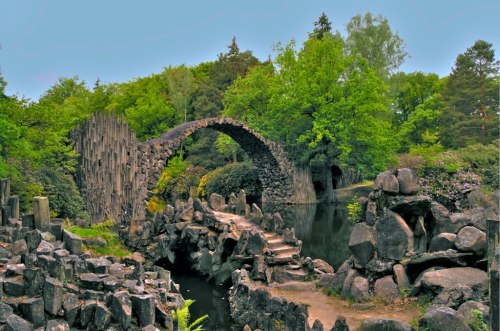
Devil’s Bridge
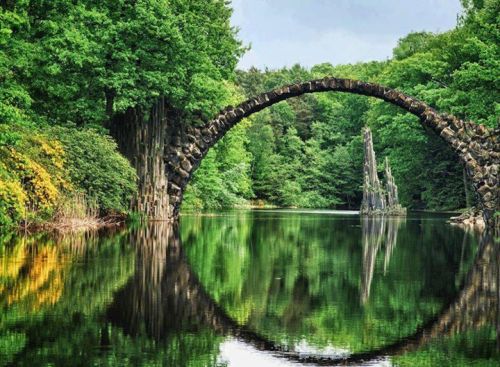
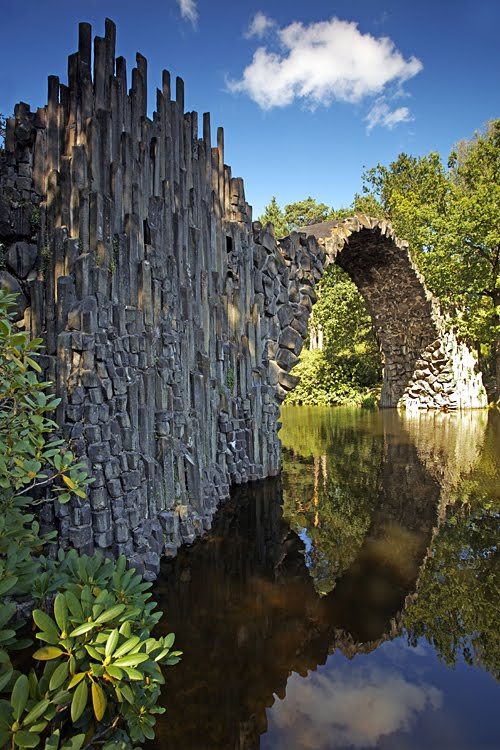
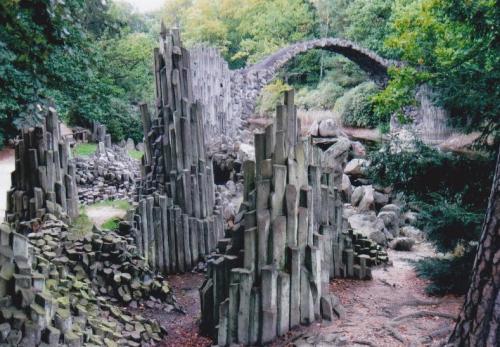
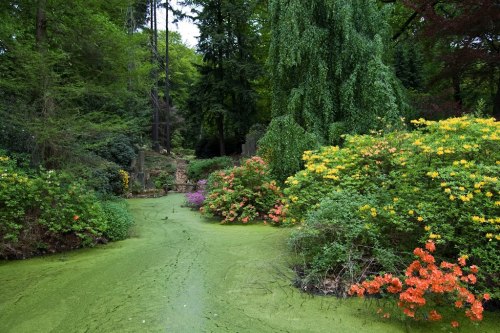
Kromlauer Park is a gothic style, 200-acre country park in the municipality of Kromlau in the Görlitz Gablenzgasse district in Germany. An incredible attraction of the park is the Rakotzbrücke, more popularly known as Devil’s Bridge.
The impressive arch bridge was built around 1860. During its construction, other peculiar rock formations were built on the lake and in the park. Devil’s Bridge is no longer open to the public to ensure its preservation. A unique feature of the bridge is that its reflection on the water’s surface creates a flawless circle, regardless of which side is being viewed.
Limestone Ostraca with the Instruction of Amennakht
1170 BCE
Late New Kingdom
The hieratic is a copy of ‘The Instruction of Amennakht’, written in literary New Egyptian, a rare example of a literary work composed by a known historical individual. His apprentice Hormin was the son of his colleague Hori and friend of his own son Amenhotep. The Teaching was probably circulated locally among the litterateurs of the village, as well as being used as a copying exercise for Amennakht’s apprentices. Some seven copies on ostraca are known, but all the others contain a shorter extract than this one.
Translation:
Beginning of the Instruction,
the verses for the way of life,
made by the scribe Amennakht
he says:You are a man who listens to a speech
to separate good from bad
- attend and hear my speech!
Do not neglect what I say!
Very sweet it is for a man to be recognized
as someone [competent] in every work.
Let your heart become like a great dyke,
beside which the flood is mighty.
Receive my utterance in all its matter;
do not be recalcitrant [so as to] overthrow [it]!
Let your eyes see every trade,
and all that is done by writing,
and you will realize the fact [that they
are] excellent, the observations I have spoken.
Do not neglect the matter!
I shall reject a long report as inappropriate.
Make great your heart (be patient?) in its haste
and speak only when you have been summoned.
You shall be a scribe and go around the House of Life
- this is how to become like a chest of writings!
(Source: The British Museum)
Culture: Zulu
Location: South Africa
A shield, cane, container, and ladle.
Wanderlust Kind Of Morning.