↧
previouslylovedplaces: Craddockville Elementary School by...

↧
archaeologistforhire: Jade mask found inside Pyramid of the...

↧
↧
SAM-AA 8938, from Middle Stone Age site, in situ in layer CD,...

SAM-AA 8938, from Middle Stone Age site, in situ in layer CD, surrounded by small hearths.
“Engravings” on a piece of ochre, from Blombos Cave South Africa, approximately 77,000 years old.
Is this the oldest artwork in the world?
[from Henshilwood, C. S., et al. (2002). Emergence of modern human behavior: Middle Stone Age engravings from South Africa. Science, 295(5558), 1278-80.]
↧
Photo

↧
archeo-zine: Mithra :: HDR by Frédéric Renaud on Flickr. Via...

Mithra :: HDR by Frédéric Renaud on Flickr.
Via Flickr:
Mithra - “Mitreo delle Terme”, Ostia Antica, Rome, Italy.
↧
↧
waffleguppies: lickypickystickyfree: A rare natural phenomenon...
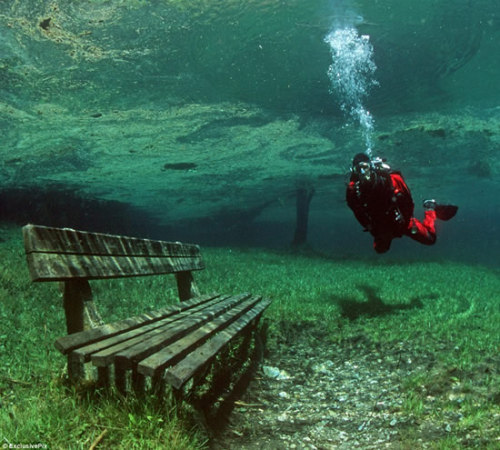
A rare natural phenomenon turns one of Austria’s most beautiful hiking trails into a 10 meter-deep lake, for half the year.
Located at the foot of the Hochschwab Mountains, in Tragoess, Styria, Green Lake is one of the most bizarre natural phenomena in the world. During the cold winter months, this place is almost completely dry, and used as a country park where hikers love to come and spend some time away from urban chaos. But as soon as temperatures rise, the snow and ice covering the mountaintops begin to melt, and the water pours down, filling the basin below with crystal-clear water.
Water levels go from one-two meters at most, to over 10 meters, in the early summer. The waters of Green Lake are highest in June, when this extraordinary place is invaded by divers, curious to see what a mountain park looks like underwater. Fish swimming over wooden benches, a grass-covered bottom, trees, roads, roads and even bridges create a surreal setting that feels like it belongs on dry ground. That’s because for half of the year, that’s exactly where it’s at.
I’m going to go here someday.
↧
assyrian-prince: Saving Ancient Nineveh [On Assyrian, Pre-Arab...


Saving Ancient Nineveh
[On Assyrian, Pre-Arab History of Mesopotamia.]
After 2,700 years, the walls and gates of ancient Nineveh can still be seen near the banks of the Tigris river just opposite the modern city of Mosul in Iraq. In ancient times, it was the capital of the great Assyrian empire, a city of more than 100,000 people, and it was a subject of a supreme being’s attention throughout the books of the Old and New Testaments in the biblical account. ”Now the word of the Lord came unto Jonah the son of Ammittai, saying, Arise, go to Nineveh, that great city, and cry against it; for their wickedness is come up before me.”[1] The prophet Jonah’s efforts there were rewarded. Nineveh, at least for a time, was saved from destruction. But the city of Nineveh today will require a different kind of saving. There are comparatively few people living there now. It features mostly ruins. Even the ruins, however, will disappear unless, according to the Global Heritage Network’s early warning system, urgent steps are taken to arrest the elements that endanger it and to restore and protect what is left.
Read the full article here:
http://popular-archaeology.com/issue/june-2011/article/saving-ancient-nineveh
↧
openaccessarchaeology: IpoTesi di...

IpoTesi di Preistoria
http://ipotesidipreistoria.cib.unibo.it/
“The journal deals with Italian Prehistory and Protohistory
The main objective of the journal is to spread to the scientific world the results of recent researches and studies concerning Italian prehistory and protohistory, in order to bring out knowledge and information on issues and contexts of the most remote ages of history.”
↧
anthrocuriosities: Shipwrecks, amphoras, and DNA offer clues to...

↧
↧
Piltdown Man: British archaeology's greatest hoax
Piltdown Man: British archaeology's greatest hoax:

In a few weeks, a group of British researchers will enter the labyrinthine store of London’s Natural History Museum and remove several dark-coloured pieces of primate skull and jawbone from a small metal cabinet. After a brief inspection, the team will wrap the items in protective foam and…
Read More Here: http://www.guardian.co.uk/science/2012/feb/05/piltdown-man-archaeologys-greatest-hoax#
↧
milesian: A Peruvian skull with evidence of early...

↧
“This is one of several alabaster reliefs found at the Palace of...

“This is one of several alabaster reliefs found at the Palace of Sargon II in Khorsabad. This particular relief features a groom holding a whip. It is obvious both form his hairstyle and skinned cloak that he was not Assyrian. The fine details are carved into the alabaster attentively and with great care. Absent of colour, the relief is rendered dynamic by virtue of the myriad of textures making up its composition.”
↧
alphacaeli: A Neanderthal partial tibia encased in breccia from...

A Neanderthal partial tibia encased in breccia from Sima de las Palomas, SE Spain. The breccia still needed to be dissolved using acid before we could get at the bone when this photo was taken.
↧
↧
kemetically-ankhtified: Black History month fact #3: Between...

Black History month fact #3:
Between 400 and 1500 CE, West Africa was thriving as a global center of commerce and trade from which rich empires emerged in Mali, Songhai, and Ghana. Mansa Musa, emperor of Mali in the early 1300s, was the richest person in the world at the time. When he passed through Cairo, he gave so much gold to the residents that the price of gold fell and the whole economy of the city was affected. The prominent city of Timbuktu flourished under the reign of Musa, and became the cultural and religious center of the world.
↧
Espacio, tiempo y forma. Serie I. Prehistoria y...

Espacio, tiempo y forma. Serie I. Prehistoria y arqueología
http://e-spacio.uned.es:8080/fedora/get/bibliuned:ETFSerieI/demo:Collection/view
The magazine Space, Time and Form was founded in 1988. It published articles on pretty much anything related to archaeology in Spanish and English (Mainly Spanish). All of their articles are available online for free.
ISSN: 1131-7698
Frequency: Annual
↧
thesherd: Although cuneiform tablets mention the ingredients...

Although cuneiform tablets mention the ingredients used for brewing, there are no details on the process. Perhaps the final drink produced by the ancient Sumerians did not contain alcohol. (via Max-Planck-Gesellschaft - The fermented cereal beverage of the Sumerians may not have been beer)
↧
Viking Mass Grave Linked to Elite Killers of the Mid-evil World
Viking Mass Grave Linked to Elite Killers of the Mid-evil World:
A mass grave found in Dorset could belong to a crew of Viking mercenaries who terrorised Europe in the 11th century – according to a new documentary on National Geographic which pieces together the story behind the burial.
↧
↧
Could Plas Tirion's Cow Shed Be Oldest House in Wales?
Could Plas Tirion's Cow Shed Be Oldest House in Wales?:

A project to find the ages of historic buildings by dating their timbers may have found one of Wales’ oldest homes.
Experts say new evidence shows north west Wales was an innovative place architecturally with cutting edge houses built in the 16th Century.
Read More Here: http://www.bbc.co.uk/news/uk-wales-16851385
↧
allmesopotamia: Assyrian king shakes hand with the Babylonian...

Assyrian king shakes hand with the Babylonian king
Size and proportion…..Giving an idea of how detailed the art work was.
↧
openaccessarchaeology: Peopled Landscapes (Terra Australis 34)-...

Peopled Landscapes (Terra Australis 34)- Now Online and Free
Archaeological and Biogeographic Approaches to Landscapes
http://epress.anu.edu.au/titles/terra-australis/peopled-landscapes-terra-australis-34
Excellent resource on Australian archaeology.
Photo- (from current issue) Hay Cave, excavation in progress.
↧