

A BRONZE Age hoard thought to have been buried more than 3,000 years ago as an offering to the gods was yesterday declared treasure after being found on a Welsh farm.
The collection of 13 bronze artefacts, including part of a bronze bracelet, fragments of a large bronze spearhead and a complete bronze socketed axe, will go on public display after the declaration by the coroner for Carmarthenshire.
Novice metal detecting enthusiast Kevin Sawyer made the discovery on land in St Ishmael, Carmarthenshire last June.
The hoard has since been identified and reported on by museum archaeologists at the National Museum Wales and is thought to date from between 1000-800BC.
Mr Sawyer, who lives in the village of Ponthenry near Llanelli, only took up the hobby six weeks before the incredible find. Read more.
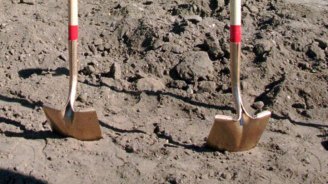
A grassy area along a busy roadway in Prince George’s County is now the site of an archaeological dig.
Specialists from the Maryland State Highway Administration are working along Annapolis Road (Rt. 450) in Bladensburg near the public library.
Officials said several prehistoric and 19th century artifacts recently were found there. By law, they can’t begin work on a new street-widening and improvement project until the items are safely removed and evaluated.
Some of the artifacts found so far include arrowheads as well as buttons and pencils believed to be from the first school house in Bladensburg.
The reason this (dig) is important is because cultural resources, archaeological sites, are not a renewable resource.
Gifts for the Gods
“a painting using the “triangular” format - another project from the Mary Todd Beam book, Celebrate Your Creative Self. I decided to do some research on Sumerian art - using some of their icons and some of their cuneiform symbols. This is a mixed media piece in which I used both watercolor and acrylics on watercolor paper. This piece is 9” x 12”.”
From: Watercolor in the Village blog (Barbara Hart Sailor)
Source: http://barbarasailor.blogspot.com/2011/04/gifts-for-gods.html
Photos & Links of Artifacts, Sites, Books, Shovels, Dirt, Etc
Places to go & fully experience.
From Ancient to Modern: Ceramics, Glassware, Metals, and Woods.
Ibn Battuta.
I strongly recommend this book:
http://www.amazon.com/Adventures-Ibn-Battuta-Traveler-Fourteenth/dp/0520243854/
ابن بطوطة | IBN BATTUTA
c:

When archaeologist Neil Brodie arrived for a dig at an ancient Roman cemetery site in Jordan, it was obvious that someone had got there before him.
“It was a desert environment and there were just all these big holes in the ground,” said Brodie. “They must have…
Petra, Jordan
Two lions carved on a sarcophagus discovered at the necropolis at Beth She’arim. A number of the sarcophagi at the site bear images of living things, while some of the catacombs (e.g. Catacomb 14) contain none, illustrating the wide variety of Rabbinic views on the use of icons in Jewish art in Late Antiquity.
Interesting thing I’m reading about today: The Windover Archaeology site near Titusville, FL. see also: America’s Bog People
I lived a bit south of Titusville in Melbourne for years, but never knew about this.
Explore your hometowns, y’all.
“Just keep reminding yourself that 5,000 years from now, no one will be able to figure out how we did it”
Humor!

“An archaeological investigation at Oihi Bay, site of the earliest permanent European habitation in New Zealand, is revealing some fascinating details of life in the Bay of Islands in a very different era.
The investigation is a joint project between the University of Otago and the…”
Read More Here: http://www.odt.co.nz/campus/university-otago/198974/archaeological-site-window-past
A South African archaeologist digs into his own past to seek connections between climate change and human development.
Metal scrapes on hard sand as archaeologist Chris Henshilwood shaves away the top layer of sediment in Blombos Cave. After just a few moments, the tip of his trowel unearths the humerus of a pint-sized tortoise that walked the Southern Cape of South Africa many millennia ago. Next come shells from local mussels and snails amid blackened soil and bits of charred wood, all remnants of an ancient feast. It was one of many enjoyed by a distinct group of early humans who visited Blombos Cave over the course of thousands of years.
The Still Bay culture was one of the most advanced Middle Stone Age groups in Africa when it emerged some 78,000 years ago in a startlingly early flourishing of the human mind. Henshilwood’s excavations at Blombos Cave have revealed distinctive tools, including carefully worked stone points that probably served as knives and spear tips, and bits of rock inscribed with apparently symbolic designs. But evidence of the technology disappears abruptly in sediment about 71,000 years old, along with all proof of human habitation in southern Africa. It would be 7,000 years before a new culture appeared, with a markedly different toolkit, including crescent-shaped blades probably used as arrowheads.
Here is the link to the source so you can Read More
“Hades wasn’t the happiest place, the Department of Motor Vehicles of the ancient Greek afterlife.
There, in a gloomy underworld, departed heroes such as Achilles gathered mostly to grouse about their boredom, and await the verdict of the judges of the dead.
“I would rather be a paid servant in a poor man’s house and be above ground than king of kings among the dead,” said Achilles, the greatest of Greek heroes,commenting on the scenery, according to the ancient poem, The Odyssey. (Tough break for Achilles, but perhaps he was later cheered to learn that Brad Pittwould play him in the 2004 filmTroy. )
But for archaeologists, a Greek cave that has sparked comparisons to Hades looks more like heaven. Overlooking a quiet Greek bay, Alepotrypa Cavecontains the remains of a Stone Age village, burials, a lake and an amphitheater-sized final chamber that saw blazing rituals take place more than 5,000 years ago. All of it was sealed from the world until modern times, and scholars are only now reporting what lies within…”
Read More Here: http://www.usatoday.com/tech/science/columnist/vergano/story/2012-02-25/Alepotrypa-Cave-Hades/53237894/1


