Cycladic three figurines group, marble, from the early cycladic II period. Currently located at the Badisches Landesmuseum, Karlsruhe, Germany.
Cycladic three figurines group, marble, from the early cycladic II period. Currently located at the Badisches Landesmuseum, Karlsruhe, Germany.
Chapel for Ramesses I at Abydos - North Wall, Ancient Egyptian, Dynasty 19, reign of Sety I (ca. 1291-1279 B.C.E.) Limestone, currently located at the Metropolitan Museum of Art, New York.
Ancient Roman mosaic of a love scene, from Centocelle. 1st century CE, currently located at the Kunsthistorisches Museum, Austria.
New York City has acquired the third and final section of the High Line, the old elevated railroad structure on the West Side of Manhattan, from CSX Transportation, clearing the way for completion of the park.
The bronze “Chimera of Arezzo” is one of the best known examples of the art of the Etruscans. It was found in Arezzo, an ancient Etruscan and Roman city in Tuscany, in 1553 CE and was quickly claimed for the collection of the Medici Grand Duke of Tuscany Cosimo I, who placed it publicly in the Palazzo Vecchio, and placed the smaller bronzes from the trove in his own studiolo at Palazzo Pitti, where “the Duke took great pleasure in cleaning them by himself, with some goldsmith’s tools,” Benvenuto Cellini reported in his autobiography. The Chimera is still conserved in Florence, now in the Archaeological Museum. It is approximately 80 cm in height.
In Greek mythology the monstrous Chimera ravaged its homeland, Lycia, until it was slain by Bellerophon. This bronze was at first identified as a lion by its discoverers in Arezzo, for its tail, which would have taken the form of a serpent, is missing. It was soon recognized as representing the chimera of myth and in fact, among smaller bronze pieces and fragments brought to Florence, a section of the tail was soon recovered, according to Giorgio Vasari. The present bronze tail is an 18th-century restoration.
The Chimera was one of a hoard of bronzes that had been carefully buried for safety some time in Antiquity. They were discovered by accident, when trenches were being dug just outside the Porta San Laurentino in the city walls. A bronze replica now stands near the spot.
Inscribed on its right foreleg is an inscription which has been variously read, but most recently is agreed to be TINSCVIL, showing that the bronze was a votive object dedicated to the supreme Etruscan god of day, Tin or Tinia. The original statue is estimated to have been created around 400 BCE.
Museo Archeologico Nazionale, Florence, commentary by Ugo Bardi
This week’s Sunday Sumerian is kalag, which means to be mighty.
Lots of languages have verbs that kind of act like adjectives. English only really has one: suck, which means, to be bad, as in the expression, “This sucks.” But Sumerian had lots of them. Kalag is just one of them.
To turn an adjectival verb into an adjective, you add -a to the end of it.
So if you want to say “mighty man,” it will be nitah kalaga, not
nitah kalag. Nitah kalag would mean something like “man to be mighty.”“Mighty woman” would be munus kalaga.
The Two Sides of the Phaistos Disc
The Phaistos Disc is a disk of fired clay from the Minoan palace of Phaistos on the Greek island of Crete, possibly dating to the middle or late Minoan Bronze Age (2nd millennium BC).
Its purpose and meaning, and even its original geographical place of manufacture, remain disputed, making it one of the most famous mysteries of archaeology. In fact, some people even think that it’s not authentic, but rather, a hoax or a forgery.
This unique object is now on display at the archaeological museum of Heraklion.
Bronze Votive Figure
Etruscan
Found near Mount Vesuvius
c.425-400 BC
Height: c.28 cm
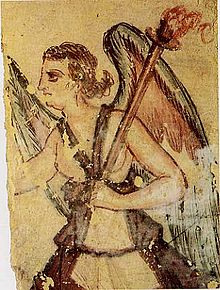
Bronze votive statuette of Vanth, an Etruscan winged demoness holding snakes in either hand. She has no direct counterpart in greek mythology though some scholars link her to the Furies. However she is shown as a benevolent guide, rather than as an avenging spirit. She appears in a variety of contexts linked to death. From the moment of death to the journey through the underworld.
Her other attributes include the torch, a key, a scroll, and she is often shown bare chested, a rolled short chiton and fur boots.
Other Etruscan underworld deities include: Charun, Calu, Phersipnai, Turms, Aita and Culsu.
Bearded Dionysos leading the Horai, Roman artwork of the Imperial Era, c. 1st century CE, copy of a neo-attic original work. Currently located at the Louvre, France.

(Armor inside the Islamic galleries of the Metropolitan Museum of Art.)
Nearly 6.3 million people visited the museum in the fiscal year that ended June 30.
Tiwanaku is an important Pre-Columbian archaeological site in Bolivia. Tiwanaku was the ritual and administrative capital of a major state, one of the most important precursors to the Inca Empire, flourishing for approximately five hundred years between 500 CE and 1000 CE. The ruins of the ancient city state are near the south-eastern shore of Lake Titicaca, about 72 km west of La Paz, Bolivia.
Because of their high elevation, crops grown by the Tiwanaku were limited to frost-resistant plants such as potatoes and quinoa. Llama caravans brought maize and other trade goods up from lower elevations. The Tiwanaku had large herds of domesticated alpaca and llama, and hunted wild guanaco and vicuña.
During the Late Formative period, the Tiwanaku Empire was in direct competition with the Huari empire, located in central Peru. Tiwanaku style artifacts and architecture have been discovered throughout the central Andes, a circumstance that has been attributed to imperial expansion, dispersed colonies, trading networks, a spread of ideas or a combination of all these forces.
After 700 years, the Tiwanaku civilization disintegrated as a regional political force. This happened about 1100 CE, and resulted, at least one theory goes, from the effects of climatic change, including a sharp decrease in rainfall. There is evidence that the groundwater level dropped and the raised field beds failed, leading to a collapse of agricultural systems in both the colonies and the heartland. Whether that was the sole or most important reason for the end of the culture is debated.
Original Greek statues were brightly painted, but after thousands of years, those paints have worn away.
MORE.
Divers say they have discovered a ship off the coast of Italy which they believe is about 2,000 years old.
The ship, which was found in the sea off the town on Varazze in the province of Liguria, is thought to be a Roman-era commercial vessel.
Fishermen in the area said they had been finding sherds of pottery in their nets for years, prompting police divers to launch a search.
The ship is said to be in a very well-preserved condition.
“The peculiarity of this is that the wreck could be almost intact,” Lt Col Francesco Schilardi of the police divers’ group told the BBC.
“We believe it dates to sometime between the 1st Century BC and the 1st Century AD,” Lt Col Schilardi said.
The mud on the seabed had hidden but also protected the wreck, he added.
The divers say that study of the vessel should help to understand commercial activity in that era.
The ship is thought to have travelled on trade routes between Spain and what is now central Italy and was loaded with more than 200 clay amphorae likely to have contained fish, wine, oil and grain.

In Ancient Egypt, death marked the beginning of life in the afterworld. The afterlife was central to Egyptian religion, so it is unsurprising that the ruling class usually possessed an abundance of funerary items. Some of the most essential burial goods were canopic jars.
Following the embalmment process, the deceased’s organs were stored in canopic jars for preservation. While the heart (“seat of understanding”) was left in the body, the intestines, stomach, lungs, and liver were all removed. Each of these organs had a corresponding protective deity, who (as in the top image) were sometimes represented in the forms of toppers. All four deities were Sons of Horus. As seen above, the falcon-headed son, Kebhesenuf, protected the intestines. Jackal-headed Duamutef looked over the stomach, while baboon-headed Hapi and human-headed Imsety protected the lungs and liver, respectively.
Canopic jars varied in their composition. The top image depicts stone jars with wooden toppers, dating to the 21st Dynasty. They belonged to Neskhons, Pinedjem II’s wife (x). King Tutankhamun’s alabaster jars (lower image) were carved in his likeness, and placed in a canopic shrine.
New Open Access article- The 2011 Field Season at the Villa San Marco, Stabiae: Preliminary Report on the Excavation
Porvenir, Fortaleza Valley, Peru
Human remains, some stained white from the blistering sun, others burnt black, are set ablaze to keep looters warm at night.I have no doubt that looters are to blame for some mind-boggling callous treatment of human remains, and may indeed be responsible for this. Still, I found an earlier set of photos of what appears to be the same scene in 2003. The blogger interprets it as a modern shrine, and there is also some additional information about the skulls.
http://vizmat.blogspot.com/2008/08/photo-taken-in-2003-by-margaret-brown.html

The archaeological research team working at Marcahuamachuco, Peru, has announced what it calls the “first important finding” in determining the site’s historical process: a collection of 10 metal figurines and many other ornamental objects, believed to be part of an offering made during the construction of the site.
Jesus Holguin, director of the archaeological team, said that the figurines represent males dressed in hats, earmuffs and clothing. The figurines, some are which are sitting cross-legged, would have been manufactured by applying a thin sheet of metal to a solid cast of stone or wood, then tapping and shaping as required. Among the ornamental objects discovered are earrings, necklaces, tupus (needles), and beads that could have been attached to canvases or banners.