Quantcast
Channel: Male Nude Photography
Viewing all 3244 articles
Browse latest View live

Maya Murals Found in Family Kitchen

$
0
0
Maya Murals Found in Family Kitchen:

oosik:

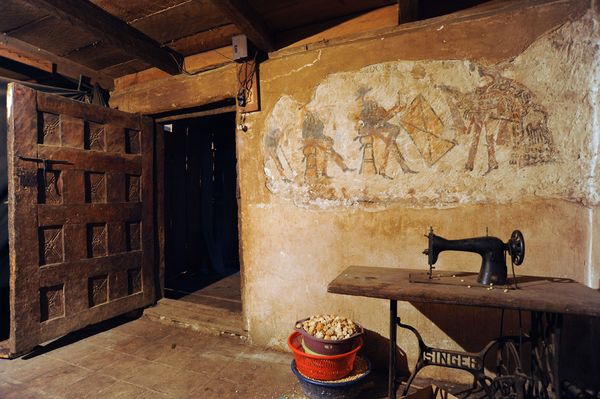
Five years ago Lucas Asicona Ramírez (far right, pictured with family) began scraping his walls while renovating his home in the Guatemalan village of Chajul. As the plaster fell away, a multi-wall Maya mural saw light for the first time in centuries, according to archaeologist Jarosław Źrałka, who recently revealed the finds to National Geographic News.

The paintings depict figures in procession, wearing a mix of traditional Maya and Spanish garb. Some may be holding human hearts, said Źrałka, who was working on the other side of Guatemala when a colleague tipped him off to the kitchen murals.

The recent exposure has faded the art considerably, leaving precious little time to unlock their secrets, he added.

That the paintings endure at all is “a fairly remarkable thing,” according to Boston University archaeologist William Saturno, who examined pictures of the murals at National Geographic News’s request and believes the art to be authentic.

“We don’t get a lot of this type of artwork; it’s not commonly preserved in the New World,” said Saturno, a National Geographic grantee. “It’d be neat to see who the folks were who painted on the wall and why.”

Read More 


scinewscom: Lost Roman Town of Interamna Lirenas Comes to...

$
0
0


scinewscom:

Lost Roman Town of Interamna Lirenas Comes to Light

European archaeologists using geophysical methods have mapped an ancient Roman town, which disappeared after its abandonment 1,500 years ago and now lies buried underground, revealing the location of its theater, marketplace and other buildings.

http://www.sci-news.com/archaeology/article00573.html

scinewscom: First Temple Period Public Water Reservoir...

Neanderthal and Human Matings Get a Date

$
0
0
Neanderthal and Human Matings Get a Date:

glubglubglubglub:

Two years ago the analysis of the Neanderthal genome revealed modern humans carry Neanderthal DNA, implying our ancestors mated with Neanderthals at some point in the past. Scientists only found genetic traces of Neanderthals in non-African people, leading to the conclusion that Neanderthal-human matings must have occurred as modern humans left Africa and populated the rest of the world. A new paper (PDF) posted on arXiv.org puts a date on those matings: 47,000 to 65,000 years ago—a time that does indeed correspond with human migrations out of Africa.

ancientart: Painting from the Ancient Greek vase Chigi olpe,...

$
0
0


ancientart:

Painting from the Ancient Greek vase Chigi olpe, mid 7th century, from the Villa Giulia Museum, Rome.

Decoration: dark-ground bands have florals and animals. Light-ground have: warriors, with round hoplite shields, kept in step by pipes-player; lion hunt and (under handle) Judgement of Paris with Paris and the three goddesses named; hare hunt with dogs (lower frieze). ‘Orientalising’ flora and fauna.

Analysis: unusual techniques of decoration, fine potting and painting, and multi-theme figure decoration suggest a special piece. Hoplite warfare was introduced at about the time this vase was made. Lion hunts that were known to have taken place in the East are copied. The hare hunt would have been common in Greece. Masculine themes suggest the vase was for men. It was exported in antiquity to northern Italy.

Source: Beazley Archive, University of Oxford

xmorbidcuriosityx: Inca Mummy: ‘Maiden’ Had Lung Infection...

$
0
0


xmorbidcuriosityx:

Inca Mummy: ‘Maiden’ Had Lung Infection When Sacrificed, Study Suggests

The so-called Maiden mummy of a 15-year-old Incan girl who was sacrificed 500 years ago is giving up some secrets, revealing the teenager suffered from a bacterial lung infection at the time of her death, scientists report Wednesday (July 25).

The researchers analyzed tissue proteins, rather than DNA, from the Maiden and another young Inca mummy who died at the same time.

Over the last decade, DNA techniques have proven useful in helping solve ancient mysteries, such as how King Tut died. But these techniques aren’t without faults. For example, finding evidence of a malaria-causing parasite in King Tut’s system doesn’t necessarily mean the Egyptian king suffered any malaria symptoms. Additionally, the environment can easily contaminate DNA samples, if researchers aren’t careful.

On the other hand, analyzing a sample’s proteins, which are less susceptible to environmental contamination, yields a whole different set of information. “Being the expression of DNA, proteins really show you what the body is producing at the time when the individual is being sampled — or, in our case, at the time of death,” study researcher Angelique Corthals, a forensic anthropologist at the City University of New York, told LiveScience. In particular, proteins can tell you if the body’s immune system has activated to fight a disease, she added.

Full story here.

victoriafolgueira: Sometimes you have to be creative. In this...

$
0
0


victoriafolgueira:

Sometimes you have to be creative.

In this case, my boss wanted a reconstruction of the ceramics to include the photos in his report. This was impossible due to the little amount of shards and the lack of connection between groups of them (besides the ethical issues). So I suggested to prepare a temporary assembly on clay to show a hypothetical reconstruction of the original shape.

These are chalcolithic vessels fom Betote (Sarria, Lugo, Spain).

jedinosaurmasterpalaeonprime: Misspelt Palaeontology tuttut


Archaeological News: Archaeologists Dig Up Graves in Ancient Roman City

$
0
0
Archaeological News: Archaeologists Dig Up Graves in Ancient Roman City:

archaeologicalnews:

Archaeologists are digging up the necropolis of Baelo Claudia, one of the best preserved Roman cities in Spain, and they report that they’ve already uncovered several intact graves that likely date back more than 2,000 years.

Founded in the late second century B.C., Baelo Claudia lies near today’s town of Tarifa at the southernmost tip of Spain, separated from Morocco by the Strait of Gibraltar. Since 2009, scientists at the University of Alicante have led excavations at the site, which is considered by some the best preserved city from the high imperial Roman period of the Iberian Peninsula. 

Read more.

Archaeological News: Ancient farm tools help dig up the past

$
0
0
Archaeological News: Ancient farm tools help dig up the past:

archaeologicalnews:

HA GIANG (VNS)—

Archaeologists recently found something unique in the northeastern province of Ha Giang: a set of five stone hoes dating back to 4,000 years ago.

After examining them carefully, scientists confirmed that the tools were made of hard riolit stone, which is abundant in the area. The tools measure 18cm in length and 7cm in width and are 2.5cm thick. Based on traces on the tools and their chipped edges, experts believe that they were tied to sticks, which served as handles, and used for quite a while.

Scientists are still examining the surrounding area. Read more.

Archaeological News: Heavenly Egyptian Charm Found in Israeli City

$
0
0
Archaeological News: Heavenly Egyptian Charm Found in Israeli City:

archaeologicalnews:

A rare scarab amulet newly unearthed in Tel Aviv reveals the ancient Egyptian presence in this modern Israeli city.

Archaeologists excavating the ancient city of Jaffa, now part of Tel Aviv, have long uncovered evidence of Egyptian influence. Now, researchers have learned that a gateway belonging to an Egyptian fortification in Jaffa was destroyed and rebuilt at least four times. They have also found the scarab, which bears the cartouche of the Egyptian Pharaoh Amenhotep III, who ruled from 1390 to 1353 B.C. Scarabs were common charms in ancient Egypt, representing the journey of the sun across the sky and the cycle of life. 

Jaffa was the site of major trading activity since the second millennium B.C. Excavations in the 1950s uncovered the Egyptian fortification, which dates back to the dynasty of Ramses II between 1279 and 1213 B.C. 

Read more.

ancientart: Male Worshiper, between 2500 and 2250 BC (Early...

$
0
0


ancientart:

Male Worshiper, between 2500 and 2250 BC (Early Dynastic IIIb), made of calcite-alabaster, and currently located at the Walters Art Museum, USA.

The shaven head, a sign of ritual purity, may identify this figure as a priest. A partially preserved inscription on one shoulder states that he prays to Ninshubur, the goddess associated with the planet Mercury.

khalishh: -Al Zahawi

coffee-n-cats: I’m sad that my reference to the Elder Scrolls’...

$
0
0


coffee-n-cats:

I’m sad that my reference to the Elder Scrolls’ Khajiit was met with silence and confusion when talking about this piece of art. 

I wonder if my slide of Battle-Axe Barbarians including Conan and Warcraft characters will blow over their heads too.

jawdust: The possible remains of Richard III have been found in...

$
0
0


jawdust:

The possible remains of Richard III have been found in a city car park

The search for the remains of Richard III took a dramatic turn today as human remains found under a Leicester car park had battle wounds consistent with the monarch’s death at the Battle of Bosworth.

Richard Taylor, director of corporate affairs at the University, said: “This skeleton certainly has characteristics that warrant further detailed examination.” Richard III was killed at the Battle of Bosworth in 1485 and buried in Leicester, although the exact location was lost.

The skull appears to have suffered a blow “consistent with an injury received in battle. A bladed implement appears to have cleaved part of the rear of the skull.” An arrowhead was also found between the skeleton’s vertebrae.

The skeleton did have spinal abnormalities, with a form of spinal curvature which “would have made his right shoulder appear visibly higher than the left”.

The team added: “This is consistent with contemporary accounts of Richard’s appearance,” adding: “The skeleton was not a hunchback and did not have a withered arm.”


souryellows: ‘Strong evidence’ that Richard III’s body has been...

$
0
0


souryellows:

‘Strong evidence’ that Richard III’s body has been found

For more than 500 years, mystery has surrounded the location of the remains of Richard III, the last Plantagenet king who was killed during his defeat at the Battle of Bosworth. Now a team of archaeologists seeking his lost grave beneath a council car park say they have made a “momentous” discovery, strongly suggesting his resting place has been found, and will reveal details of their find today. If confirmed, the breakthrough will complete the first successful search for the lost grave of an English king.

Photo

breakingnews: Archaeologists believe they may have found the...

$
0
0


breakingnews:

Archaeologists believe they may have found the lost bones of England’s King Richard III

BBC News: Archaeologists searching for the grave of Richard III have said ‘strong circumstantial evidence’ points to a skeleton being the lost king.

The English king died at the battle of Bosworth in 1485.

A dig under a council car park in Leicester has found remains with spinal abnormalities and a “cleaved-in skull” that suggest it could be Richard III.

Photo: Archaeologist Mathew Morris stands in the trench where he found skeleton remains during an archaeological dig to find the remains of King Richard III in Leicester, central England September 12, 2012. (REUTERS/Darren Staples)

archaeology: Syria’s Looted Past: How Ancient Artifacts Are...

$
0
0


archaeology:

Syria’s Looted Past: How Ancient Artifacts Are Being Traded for Guns

Photo: The badly damaged outer gate of Aleppo’s Citadel after government opponents try to blast their way into the ancient fortress.

Abu Khaled knows the worth of things. As a small-time smuggler living along the porous border between Syria and Lebanon, he has dabbled in antiquities as much as the cigarettes, stolen goods and weapons that make up the bulk of his trade. So when a smuggler from Syria brought him a small, alabaster statue of a seated man a few weeks ago, he figured that the carving, most likely looted from one of Syria’s two dozen heritage museums or one of its hundreds of archaeological sites, could be worth a couple thousand dollars in Lebanon’s antiquities black market. So he called his contacts in Beirut. But instead of asking for cash, he asked for something even more valuable: weapons.

“War is good for us,” he says of the community of smugglers that regularly transit the nearby border. “We buy antiquities cheap, and then sell weapons expensively.” That business, he says, is about to get better. Fighters allied with the Free Syrian Army units battling the regime of Syrian President Bashar Assad have told him that they are developing an association of diggers dedicated to finding antiquities in order to fund the revolution. “The rebels need weapons, and antiquities are an easy way to buy them,” says Abu Khaled, who goes by his nickname in order to protect his identity.

Criminal activity thrives in chaos, and the theft of antiquities for a rapacious international black market is no exception. Lebanon, Iraq and Afghanistan have all fallen victim to looters during previous wars, and Libya and Egypt, rich in archaeological sites, witnessed several attempts at looting during their more recent uprisings. In the case of Syria, however, the full-blown civil war may do more harm than simply the plundering of its culture. The burgeoning market for this ancient land’s priceless treasures could actually prolong and intensify the conflict, providing a ready supply of goods to be traded for weapons. Furthermore, the ongoing devastation inflicted on the country’s stunning archaeological sites—bullet holes lodged in walls of its ancient Roman cities, the debris of Byzantine churches, early mosques and crusader fortresses—rob Syria of its best chance for a post-conflict economic boom based on tourism, which, until the conflict started 18 months ago, contributed 12% to the national income.


Read more: http://world.time.com/2012/09/12/syrias-looted-past-how-ancient-artifacts-are-being-traded-for-guns/#ixzz26Ih3K6z9


Anthropology a Science? Statement Deepens a Rift

$
0
0
Anthropology a Science? Statement Deepens a Rift:

Anthropologists have been thrown into turmoil about the nature and future of their profession after a decision by the American Anthropological Association at its recent annual meeting to strip the word “science” from a statement of its long-range plan.

This is an older article from 2010; however, this questions still remains unsettled to many in academic community. The fact that is question continues to remain apart of discourse saddens, but perhaps someday, the greater discourse of science will always continue this “soft” social science.

Viewing all 3244 articles
Browse latest View live