“History is, strictly speaking, the study of questions; the study of answers belongs to anthropology…”
-
-
Sarcophagus with Dionysus and Ariadne, Roman Imperial (190-200), made of Proconnesian marble.
Currently located at the Walters Art Museum, USA.
The curse of King Tut’s man-boobs: Was Tutankhamen killed by disease which gave him breasts?
He was revered as a living god, the most famous of a glittering dynasty who ruled over one of the world’s greatest civilisations.
But a new theory suggests the Egyptian Pharaoh Tutankhamen and many of his immediate predecessors suffered from an all too common affliction - the dreaded man-boobs.
Hutan Ashrafian, a British surgeon, believes it could explain the reason for King Tut’s death in his teens - a question that has baffled historians for decades.
Dr Ashrafian, of Imperial College London, points out that Tutankhamen and his immediate predecessors all died young and had distinctly feminine physiques.
Smenkhkare, a pharaoh who is believed to have been Tutankhamen’s uncle or older brother, and Akhenaten, thought to have been the boy’s father, are depicted in paintings and sculptures with wide hips and large breasts.
Dr Ashrafian points out that each pharaoh died at a slightly younger age than his predecessor, suggesting an inherited disorder.
Full story and more photographs here!
The historical potential here is incredible.
(As is the potential for creative inspiration of all sorts.)
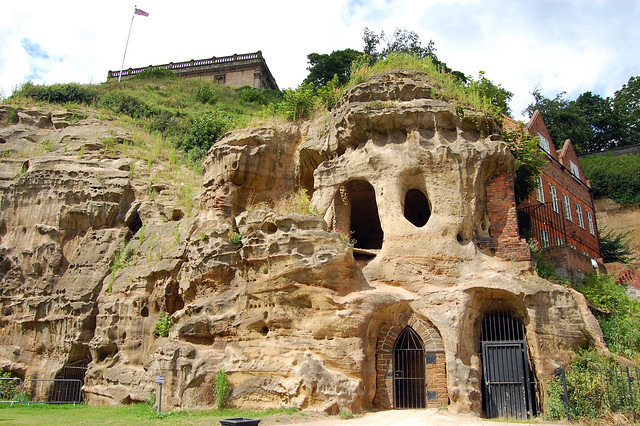

For severalyears now, I’ve admired from afar the ambitious laser-scanning subterranean archaeological project of the Nottingham Caves Survey.
Incredibly, there are more than 450 artificial caves excavated from the sandstone beneath the streets and buildings of Nottingham, England—including, legendarily, the old dungeon that once held Robin Hood—and not all of them are known even today, let alone mapped or studied. The city sits atop a labyrinth of human-carved spaces—some of them huge—and it will quite simply never be certain if archaeologists and historians have found them all.
“Even back in Saxon times, Nottingham was known for its caves,” local historian Tony Waltham writes in his helpful guide Sandstone Caves of Nottingham, “though the great majority of those which survive today were cut much more recently.” From malt kilns to pub cellars, “gentlemen’s lounges” to jails, and wells to cisterns, these caves form an almost entirely privately-owned lacework of voids beneath the city.


Check out the post linked above for much more detail and many more pictures.
Ivory Assyrian plaque that dates back to the 8th century BCE.
Now located at The Metropolitan Museum of Art, New York City, NY.
Photo by Babylon Chronicle
Poachers kill 100 South Africa rhinos in 2 months
The rate of the slaughter likely means that the year’s final tally will pass last year’s carnage of 448 animals poached.
1Baalbek
“Baalbek, also called Heliopolis, is a spectacular archaeological site in northeastern Lebanon. From the 1st century BC and over a period of two centuries, the Romans built three temples here: Jupiter, Bacchus and Venus. Created to be the largest temple in the Roman empire, the temple of Jupiter was lined by 54 massive granite columns each each of which were 21 meters (70 feet) tall. Only 6 of these titanic columns remain standing but even they are incredibly impressive. The best preserved temple at the site is the Temple of Bacchus built in 150 AD. The ancient Roman temple was dedicated to Bacchus, also known as Dionysus, the Roman god of wine. Today, it is one of the top tourist attractions of a Roman tour in Lebanon.”
Jason Novak’s charming illustrated alternative history of how the letters of the alphabet originated. For the true story, see the fantastic Shapes for Sounds, then wash down with Edward Gorey’s Thoughtful Alphabets.
(↬ Page Turner)
Ladies and Gentlemen,
Welcome to LoveArchMag Issue 2: Human Bodies. As usual, only a day late. We’re nothing if not consistent.
Read, enjoy, share.
Truly,
The LoveArchMag Team
Open publication - Free publishing - More archaeology
Ladies and gentlemen,
We are proud to announce that Issue 1 of Love Archaeology Magazine is NOW ONLINE! And only a day late. What kind of postgrads would we be if we handed things in on time?
Read, enjoy, share.
Truly,
The Love Archaeology Team
PS: Don’t use Internet Explorer. It seems LoveArchMag is way too good for that.
PPS: PDF versions available here.
http://issuu.com/lovearchaeologymagazine/docs/love_archaeology_magazine_issue1

An ancient skull found in a cave in the Annamite Mountains in northern Laos has revised our conceptions of when humans first occupied Southeast Asia and Australia.
Thanks to an ambitious conservation project and some tiny pieces of plastic, the ancient Egyptian mummy case of Hor is now on display in the Fitzwilliam Museum, at Cambridge Univ.
The conservation of the cartonnage mummy case was undertaken with the assistance of the Department of Engineering, who helped construct clever frames to support the delicate case during conservation and a new display case with internal supports using LEGO.
The mummy case was found in the Ramesseum at Thebes in 1896. The gilded wooden face had been torn out by robbers and the mummy removed. Cartonnage is a uniquely Egyptian material, often only a few millimeters thick, consisting of layers of plaster, linen and glue. It is remarkably rigid but also very sensitive to humidity. At some point Hor had been exposed to damp conditions and had sagged dramatically around the chest and face. This caused structural problems and also serious cracking and instability in the painted decoration. There had been some attempts at repair and restoration, most probably in the cartonnage’s early years in the Museum.
Muslims In Libya Condemn Violence, Apologize To Americans
#of course the news won’t show this #no they’ll just keep stating over and over that the US is sending two warships to the area #because that is more important than showing Americans that not all Muslims are evil like they already believe#because that would be asking too much of the media
http://archaeologicalnews.tumblr.com/
Follow them. :)
Colonial Williamsburg’s Historic Trades brickmakers are providing expertise and hands-on help as Jamestowne Rediscovery staff replicate the “mud-and-stud” construction method used by the very earliest Jamestown Island colonists.
fforts to duplicate the construction method used in 1607 have been ongoing for the past year at the partially reconstructed “barracks” structure inside the original palisade of James Fort. Testing and demonstration of the building technique has been conducted by Jamestown Rediscovery senior archaeologist Dave Givens — with other staff members and students — and Colonial Williamsburg’s brickmakers — journeyman Jason Whitehead and apprentice Josh Graml.
“Digging and finding below ground remnants of buildings is only a first step for us to understand early Jamestown,” archaeological project director Dr. William Kelso said.
“The Gujarat High Court on Wednesday issued notices to the state archaeology department as well as the municipal authorities here and sought explanation on why all encroachments around the historical and archaeological sites in the city should not be demolished immediately.
Managing Trustee of Isan Malik Namaji Committee, Amjad Hussain Shaikh has filed a petition objecting the encroachment around the historical Isan Malik Mosque, which has been declared as a protected monument by the state government under the provisions of the Gujarat Ancient Monuments & Archaeological Sites & Remains Act, 1965.
“Isan Malik Mosque not only signifies the historical values but it also has the name Isanpur for a whole area of Ahmedabad city with significant population,” said advocate Aniruddh Mavalankar, who represents petitioner in the court.
As per the petitioners, there are almost 19 shops and other illegal constructions, erected in such a way that has not only blocked the entrance of the mosque, but has also raised fears that the protected monument could be damaged.
The petitioner had further stated that under the Gujarat Ancient Monuments and Archaeological Sites & Remains Act, 1965 the adjacent area of the protected monument is considered prohibited or restricted area for the construction, erection or execution of building.
“In 2002 post-Godhra riots, this mosque was damaged and worshippers stayed away from offering namaz here. Then councillor Govind Thakor took advantage of the deserted site and constructed some shops and later others also followed him,” alleged the petitioner.
“We have demanded the demolition of illegal construction and clear the historical site from the dangers of damage and defacement,” said Mavalankar.”
Click through to read more….

Victor Thompson’s research doesn’t take place in a library or museum. His research is at an island in the Caribbean.
Thompson is a University anthropology professor specializing in archaeology. He recently traveled to the island of Mustique with his wife, who is a fellow anthropologist, and colleagues from the University of Oregon and the Netherlands.
The group worked to answer some basic questions about the history of the island, such as when it was colonized and how it fits into the larger picture of the development of the surrounding islands.


