Quantcast
Channel: Male Nude Photography
Viewing all 3244 articles
Browse latest View live

Syria's Future Lies in Ruins

$
0
0
Syria's Future Lies in Ruins:

conservenee:

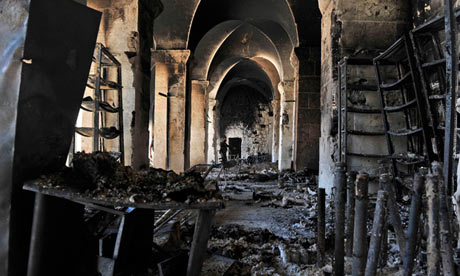
Syria is losing something it will never get back.

To mourn Syria’s devastated archaeological and architectural heritage may seem trivial. Yet with it die precious traditions

A Syrian rebel (rear) walks inside a bur

Inside the burnt-out Umayyad mosque in the old city of Aleppo, Syria, this week. 


thejadecompendium: Evidence of Viking Outpost Found in...

Archaeological News: Mysterious Bear Figurines Baffle Archaeologists

$
0
0
Archaeological News: Mysterious Bear Figurines Baffle Archaeologists:

archaeologicalnews:

In the 1950s, the now deceased Danish archaeologist Jørgen Meldgaard made a mysterious discovery in northeastern Canada:

A small, headless bear figurine, carved from a walrus tusk, was lying leaning up against the back wall of a stone fireplace in an old settlement. The bear had been positioned in a way that made it look as though it was ‘diving’ into the fireplace.

At the time, this little figurine didn’t cause much of a stir. It was just one out of a long series of discoveries that Meldgaard made during his field trips to the Igloolik region of Arctic Canada and Greenland in the 1950s and 1960s.

But when researchers at the Danish National Museum recently gained access to Meldgaard’s surviving diaries, records and photos, they realised that the discovery of the bear figurine was indeed quite sensational. 

Read more.

archaicwonder: Sacred Oracle at Dodona by lunar light on...

$
0
0


archaicwonder:

Sacred Oracle at Dodona by lunar light on Flickr.

The Oracle of Dodona in Epirus in northwestern Greece, was an oracle devoted to a mother goddess identified at other sites with Rhea or Gaia, but here called Dione, who was joined and partly supplanted in historical times by the Greek god Zeus.

ancientart: A child holding a dog, detail of the Ancient Roman...

Photo

thepressingpigeon: “Archaeology is the search for fact, not...

Archaeological News: Historic Shipwreck Identified At Channel Islands National Marine Sanctuary

$
0
0
Archaeological News: Historic Shipwreck Identified At Channel Islands National Marine Sanctuary:

archaeologicalnews:

Washington, DC—(ENEWSPF). Seventy years after it was scuttled off Los Angeles, Calif., government archaeologists have found the wrecked remains of a rare Pacific Coast schooner that was employed in the lumber trade during the early 1900s.

Today, Robert Schwemmer, maritime archaeologist for NOAA’s Office of National Marine Sanctuaries, presented a scientific paper on the George E. Billings history and its discovery in February 2011 at the eighth California Islands Symposium in Ventura, Calif.

The Billings, a five-masted schooner built in 1903 by Halls Bros. of Port Blakeley, Wash., hauled lumber from the Northwest to Hawaii, Mexico, South America, Australia and southern California. After decades servicing the lumber trade it was converted into a sport-fishing barge. In 1941, the owner decided to scuttle the aging vessel off the coast of Santa Barbara Island. 

Read more.


Archaeology digs connect Jerusalem students with history and other cultures

Prehistoric find among archaeology from Bury St Edmunds dig on show at town museum

$
0
0
Prehistoric find among archaeology from Bury St Edmunds dig on show at town museum:

Finds from a site near Cotton Lane were on display ay Moyses Hall Museum   Pictured: Rachel Clarke from Oxford Archeology

Prehistoric flint and what archaeologists describe as a ‘star find’ an intact tin glazed 17th century apothecary jar, are among the finds that have gone on show at Moyse’s Hall Museum in Bury St Edmunds.

Oxford Archaeology East made lots of finds big and small while digging a 50m by 30m site off Cotton Lane. The site is due to become retirementhomes.

The team returned to dig a smaller section at the site this week. The items will be on display for several weeks

‘Most important’ archaeological finds for a century found in village

$
0
0
‘Most important’ archaeological finds for a century found in village:

A plate  A skeleton from the Roman cemetery

ARCHAEOLOGICAL finds described as ‘the most important’ to be discovered in North Somerset for 100 years have been unearthed in Banwell.

Bristol Water has been laying a seven-kilometre, £3.6million main between Banwell and Hutton, and archaeologists employed to investigate remains along the work route discovered a horde of Roman artefacts in the village.

Bristol Water’s Jeremy Williams said of the discovery: “We are told that the finds rewrite the known interpretation of Roman Banwell and are of regional significance.”

Among the discoveries was what appears to be a Roman cemetery containing several human burials, 9,000 pieces of pottery, several copper brooches and a coin from the reign of Roman emperor Constantine the Great.

xmorbidcuriosityx: Viking chieftain’s burial ship excavated in...

$
0
0


xmorbidcuriosityx:

Viking chieftain’s burial ship excavated in Scotland after 1,000 years

Timber fragments and rivets of vessel, and deceased’s sword and shield, unearthed undisturbed on Ardnamurchan peninsula

A Viking ship, which for 1,000 years has held the body of a chieftain, with his shield on his chest and his sword and spear by his side, has been excavated on a remote Scottish peninsula – the first undisturbed Viking ship burial found on the British mainland.

The timbers of the ship found on the Ardnamurchan peninsula – the mainland’s most westerly point – rotted into the soil centuries ago, like most of the bones of the man whose coffin it became.

WOW! Full article here!

xmorbidcuriosityx: Are bodies of 10,000 lost warriors from...

$
0
0


xmorbidcuriosityx:

Are bodies of 10,000 lost warriors from Battle of Hastings buried in this field?

Historian believes the 10,000 victims of the Battle of Hastings may be buried in a field one mile north west of the official site at Battle.

The site of where the Battle of Hastings has been commemorated for the last 1,000 years is in the wrong place, it has been claimed.

Ever since the 1066 battle that led to the Norman Conquest, history has recorded the event as happening at what is now Battle Abbey in the East Sussex town.

But although some 10,000 men are believed to have been killed in the historic conflict, no human remains or artefects from the battle have ever been found at the location.

This has given rise to several historians to examine alternative sites for the battle that was a decisive victory for William the Conqueror and saw the death of King Harold.

Now historian and author John Grehan believes he has finally found the actual location - on a steep hill one mile north west of Battle.

Full article here.

sciencespook: Creepy Crypts and Catacombs Feast your morbidly...

$
0
0

Santa Maria della Concezione church in Rome


Eternal City house, Rome


Pharaoh Ti's statue to guard his sepulcher in Saqqara, Egypt


Phoenician tophets in the colony of Carthage, Tunisia


Skulls and bones of 4,000 Capuchin monks in Santa Maria della Concezione, Rome


Tomb of Ramses II, Egypt


Capuchin catacombs in Palermo, Sicily


Mummified monks at the Capuchin monastery in Palermo, Sicily


Skeleton in a tomb complex in the Valley of the Kings, Egypt, possibly one of the many sons of Pharaoh Ramses IIe

sciencespook:

Creepy Crypts and Catacombs

Feast your morbidly curious eyes on this season-appropriate gallery by National Geographic. From the bones of 4,000 Capuchin monks who have been used in a strange art to decorate rooms, to Pharaoh Ti erecting a statue of himself to guard his own tomb from looters, this gallery creepily demonstrates humankind’s fascination with death.

department-of-misanthropology: I have class one story up from...


Archaeological News: 2,000 Years Of History: Paris in 3D

$
0
0
Archaeological News: 2,000 Years Of History: Paris in 3D:

archaeologicalnews:

The latest project from Dassault Systèmes with the help of historians and archaeologists is the remarkable Paris 3D Saga, an interactive model that guides you through two millennia of Paris’ history.

You are taken through the French capital at various stages of its’ development from 52 BC Gallic Oppida through the Roman city and on to the present day. You can witness the construction of the Bastille and Notre Dame and walk through winding stone streets in the middle ages and then visit the 1889 World’s Fair to see the Eiffel Tower just after completion.

The Paris 3D Saga let’s you experience the city like you have never seen it before. Go on a journey through more than 2000 years of history: 

Read more.

Archaeologists find burnt stucco floor related to astronomical event 1,350 years ago

$
0
0
Archaeologists find burnt stucco floor related to astronomical event 1,350 years ago:

tlatollotl:

TECOZAUTLA, MEXICO.- During the excavations in Pañhu, an archaeological zone which will soon open its doors to the public in the municipality of Tecozautla, Hidalgo, archaeologists registered a burn stucco floor, evidence that its main pyramid was desacralized approximately 1,350 years ago. This coincides with an astronomical event which was thought, by its inhabitants, to be a cataclysm. 

Archaeologist Fernando Lopez Aguilar, director of the site’s investigation project promoted by the National Institute of Anthropology and History (INAH – Conaculta), informed that there was a solar eclipse at sunrise the 3rd of August in the year 650 AD. 

“To these old societies, the eclipse must have represented a catastrophe which is why they made sacrifices in order to ‘keep the star alive’, since they believed the black sun or hell’s sun had imposed on their sun ‘a giver of life’. This event generated a gradual abandonment in Teotihuacan and also had repercussions in Pañhu”, the investigator explained. 

This phenomenon, Lopez Aguilar said, was interpreted as an omen to leading to the end of the cycle, so in Pañhu they decided to desacralize the main pyramid –to the north, over the plateau where the site is located– and to dig and extract the offerings to the tutelary god. This god was probably the Old Fire God, also known as Huehueteotl, Xiuhtecuhtli or the name he was called by the Otomi people, Otontecuhtlu. 

Over the remains of this construction (400 – 650 AD) they built another in a different style which was appropriate to the architecture of the Late Classic period (650 – 900 AD) in the region of Huichapan, where other settlements where distributed (this includes Pañhu). The Pañhu where characterized for settling over plateaus and for keeping extensive economic links. Such has been confirmed by the finding of the turquoise originated from New Mexico, the jadeite of Valle de Motagua (Guatemala) and shells from the Gulf of Mexico.

This area, according to the archaeologist, was also the scene where one of the most important myths (The Snake) of Mesoamerican culture was created. This is where the god Huitzilopochtli defeated his brothers, the Centzohuiznahua and the Coyolxauhqui. 

“In the territory that goes from the Cerro del Aguila, next to Pañhu, to Cerro del Astillero (towards the southeast and also identified as the mythical Coatepec), a conflict ensued which in pre Hispanic times would give this region the name ‘Teotlapan’, ‘Land of the Gods’, and which in modern day is Mezquital.” 

The Pañhu Archaeological Project team infers the former vision that the Otomi people contributed very little to the Mesoamerican culture “can be attributed to the dominant culture: the Mexica, although Otomi speaking villages that inhabited this place possibly since the year 400 AD, were already identified with these sacred places (Cerro del Aguila, Coatepec, among other) and hid their knowledge and their customs”. 

After the archaeological work carried out in the 80’s, when a preliminary exploration of Pañhu structures was done in the Valle del Mezquital Project of ENAH, and after a period of five years of uninterrupted labors (2007 – 2012), this archaeological zone is ready to open to the public. The site will have an interpretative hall which will work with a wind turbine and a solar panel, self-sustainable energy sources. 

Archaeological News: Iraq’s rich history tempts relic smugglers

$
0
0
Archaeological News: Iraq’s rich history tempts relic smugglers:

archaeologicalnews:

Iraqi police have confiscated scores of artifacts and arrested two smugglers in the southern Province of Dhiqar, al-Zaman news reported on Monday.

The stolen items include rare statues and coins from different periods in Iraq’s ancient history.

The two smugglers in question have long been dealing in stolen relics.

One police source was quoted as saying on condition of anonymity: “Interior Ministry forces in coordination with the Iraqi army seized 64 archaeological pieces as well as 114 bronze coins in a district of al-Fajir.” 

The province of Dhiqar holds some of the most archaeologically precious excavation mounds in Iraq. Its historical treasures have turned it into a hub for smugglers and illegal diggers. 

Read more.

ancientpeoples: Women of Ancient Babylon The best known and...

$
0
0


ancientpeoples:

Women of Ancient Babylon

The best known and most complete of the ancient pre-Roman law codes is that of Hammurabi, 1800 BC ruler of Babylon.  It was the Hammurabi Code that said that one who destroys the eye of another should have his own eye put out as punishment and one who murders should himself be put to death, thus giving rise to the expression “an eye for an eye and a tooth for a tooth”. 

It is unlikely that Hammurabi was a great jurist making up laws on the spot, but rather a pragmatist who sought to put in writing the judicial practices of his day.  Victims expected to be avenged; putting the penalties in writing acknowledged society’s interest in crime and punishment and sought to establish a maximum retribution.  All too often the victim or his family had gone beyond what the perpetrator or his family thought was appropriate and had begun an endless cycle of revenge.  Hammurabi felt that once the perpetrator had paid the price the incident should be considered closed.

    Elsewhere in this website I have stressed the need to look at the past through its own eyes and not through our own.  The following principles might well be questioned today but their validity in the Ancient World was regarded as self-evident:

  1. Social order was more important than individual rights
  2. Women’s sexuality should be sacrificed to ensure legitimacy
  3. A family’s wealth should be administered by the husband/father
  4. Women, especially widows and divorcees, needed society’s help

Keeping these axioms in mind will help us see Hammurabi’s Law Code in the same way the Babylonians saw it.  Numbers in brackets refer to the section numbers in the code.

    Perhaps the clearest example of the sacrifice of individual rights on the altar of social order is the provision that would spell death for the builder’s son if a new house collapsed and killed the owner’s son.  A wife may or may not have been considered property in the same way a son or daughter was, but her sexuality belonged exclusively to her husband, and any interference therewith had to be punished as much as any other serious theft. 

    Many in today’s world are worried that population growth will soon outstrip the resources of planet earth.  The reverse was true in the Ancient World where society needed more and more workers and families needed young people as a guarantee the old would not be left destitute and lonely.  People took pride in having a large number of offspring for they were living up to their social responsibilities and, of course, guaranteeing they would have someone to look after them in old age.

    Unwanted babies were exposed by many ancient societies.  Should the children of a slave or concubine be raised by their mother as a separate family or together with the other children of the father and his wife?  To the extent allowed by the laws of each society, fathers regularly had to decide whether to claim any newborn as his child.  At the head of the list of undesirable babies were those conceived as the result of a wife’s affair.  While motherhood was obvious, fatherhood was not.  The solution was to place severe restrictions on female sexuality.  The double standard would remain almost universal until the development of a reliable means of birth control in the second half of the Twentieth Century.

In the Industrial World it is possible for men or women to live on their own for a period of time between leaving their parents’ home and getting married.  That option does not exist in an agrarian society.  If people are going to live in family units anyway, perhaps it makes sense to have assets owned by the family, not the individual.  While Babylonia appears to have had no law against women owning property, they did not do so as a matter of course.  In the normal state of affairs, the husband or father was the custodian of the family assets.

The Ancient World knew perfectly well that all of this left women at a certain disadvantage.  The system worked very well in normal, happy marriages, but when disaster struck, whether it be death, desertion or divorce, it was usually the woman who paid the price.  We need to look at how the legal system attempted to redress this economic inequality.

Most women expected to marry and have a family.  A fair body of love poetry would suggest that girls did have some say, but marriage, at least in theory, was arranged by their fathers or brothers.  According to the Hammurabi Code a contract was necessary to make a marriage.  Based on the few that have survived, the contracts dealt mainly with what would happen if the marriage ended through death, divorce or desertion, but other clauses might exempt each from the other’s prenuptial debts or even require the bride to serve as servant to her mother-in-law.

The most important item to be negotiated was the size of the bride price. 

            We have seen that pre-literate societies used bride price to compensate the bride’s family for the loss of labor and Israelite society restricted it to a token amount as a symbol of engagement.  In Babylonia the bride price almost always became part of the dowry.  Depending on social status, the bride price could represent a significant transfer of wealth—-perhaps a house and several acres of land—- but at the bottom of the economic ladder it might have been little more than an item of furniture or some kitchen utensils.  Whatever it was it was, it became part of the new household’s assets and as such was administered by the husband, but legally it had to be kept separate for it was designed for the support of the wife and her children.  (151-152)

It frequently happened that the bride remained in her father’s house for as much as a year after the contract was signed.  If in the course of that time the groom changed his mind he did not have to marry her but he lost the full bride price. (159)   The bride’s father might also have changed his mind, in which case he would have been required to refund the purchase price in full (160). If a wife died before giving birth to a son the dowry, less the bride price, was returned immediately to her father’s house (163-164).  We will see later how the law strictly regulated the disposal of the dowry in other cases.  Daughters did not normally inherit anything from their father’s estate.  Instead they got a dowry that was intended to offer as much lifetime security for the bride as her family could afford.

At marriage a woman’s sexuality became the property of her husband.  Adultery was defined in Babylonia as elsewhere in the ancient world as a sexual relationship between a married woman and a man not her husband.  The marital status of the man was irrelevant.  Even the appearance or possibility of adultery was taken very seriously.  A wife caught in the act of adultery was to be tied to her lover and thrown into the water and drowned.   A husband could save his wife but then he had to save her lover as well.  (129) 

By its nature adultery is a secretive activity, yet the mere possibility of such a serious offence was disruptive of the social order.  If a woman’s husband accused her she may in the presence of a priest swear to her innocence and then return to her husband’s home.  If someone else accused her she would have to undergo an ordeal in which she would swear before the gods to her innocence and then jump into the river.  If she drowned it was a sign of guilt; if she survived it meant that the river spirits knew of her virtue and saved her.  (Note that this is the reverse of the medieval European ordeal.)  To the modern mind judgment was based on the woman’s ability to swim, but the ancient Babylonians were convinced of supernatural intervention.  Swearing innocence was not as easy as it sounds because most people were quite certain that the gods would punish anyone who lied in their names, but any wife willing to risk divine retribution was free to return to her home if her only accuser was a jealous husband.  If an outsider laid the charge the woman was likely to lose because few in Babylonia knew how to swim.  Whatever the justice of the verdict for the individual, the matter was settled and order was restored in the community. (131-132)

Although marriages were arranged by the parents, there is no reason to suppose that they did not involve considerable love, affection and mutual support.  Some relationships were bound to fail, however, and the code spelled out in considerable detail all of the options.  If he simply ran away and deserted her she was free to marry someone else; even if he returned later he could not reclaim her; nor could she opt to return to her first husband: the Code, not the woman, made the choice.  (136) 

A man could divorce his wife without giving a reason, but if she had borne him children there were some serious conditions:  she kept the children; she got the dowry; she also got the use of a field or property so she could raise her children. When her ex-husband died she got a portion of his estate equal to that given to each of her sons and was free to marry someone else. (137)  If a wife had no children she could be divorced by simply returning her dowry along with a sum equal to the purchase price.  If there was no purchase price he had to give her one mina of gold.  A shepherd could expect to take about six years to earn such a sum so in theory at least it could have been invested to go some way to maintain her. (137-140)

If the woman wanted out of the marriage or if the husband wished to avoid returning the dowry the courts had to be involved.  If she could demonstrate her innocence and his neglect she could take her dowry and children and return to her father’s house.  If it were established, however, that she was to blame and had neglected her house and husband, then he sent her away without dowry or children; if he wished, he could opt to keep her as a servant.  In serious cases the court might rule that she should be thrown in the water and drowned. (141-143) 

Throughout the Ancient World childlessness was considered to be a serious problem.  If a wife failed to bear children she might give her maidservant to her husband.  If the maidservant produced a baby it counted as the wife’s child.  If such a maidservant started to take on airs and act the equal of the wife she could not be sold but she would be kept strictly as a slave.  If neither wife nor maidservant produced a child a man was permitted a second wife but again she was not allowed to be equal in status to the first wife.  If his wife acquired a long-term illness he could take a second wife but he must continue to look after his first wife for as long as she lives.  She could take her dowry and return to her father’s house if she wanted to do so: the choice was hers. (144-149)

A wife’s dowry was administered by her husband as part of the family assets.  He had no say, however, in its ultimate disposal.  If she died childless, her dowry reverted back to her family—-her father, if he was alive, otherwise her brothers.  If she had sons, they would share it equally.  A man divided his estate among his sons after having provided a suitable dowry for each daughter and an appropriate bride price for each son.  If he died before arranging all of this his heirs were expected to do so before dividing the balance of the estate.  If a man had children by two wives, all of his sons shared his estate  equally; they got a portion of their birth mother’s dowry but nothing from their stepmother.  (166-167, 183-184)  Likewise a woman who had children by two husbands divided her dowry equally among her sons by both marriages. (173)

If in life the father acknowledged sons by a slave or concubine, they were entitled to share equally in his estate.  If he had not acknowledged them they had no right to inherit, but the slave or concubine and her children were freed on his death.  (170-171)

The marriage gift was property set aside at the time of the marriage for the support of the bride after the death of her husband.  If no such gift was made a widow was entitled to a share of her husband’s estate equal to that of a son.  She also had the right to remain in the family home for as long as she lived.  If she opted to remarry she would, of course, have to move and she would lose the marriage gift.  A widow with dependent children required judicial consent to remarry.  Her first husband’s assets were inventoried and kept in trust for his children.   (172, 177)

A father might have dedicated a daughter to serve a particular god as a nun.  Apparently some girls made this choice themselves as an alternative to an undesirable marriage.  The nun was still entitled to her share of her father’s property as a dowry even if she did not marry.  Unless he gave it to her outright it would be administered by her brothers on her behalf after their father died. (178-182)  If she became a hierodule (a lady of high standing in a temple) or a Marduk priestess her dowry was only a third of the normal size because such women had a number of tax advantages.

(Information from: womenintheancientworld.com)
archaicwonder: The stables of Shivta  Shivta - the ancient...

$
0
0


archaicwonder:

The stables of Shivta 

Shivta - the ancient Nabataean town in the middle of the Negev desert (south-west side of Israel) is an amazing place. The classic Nabataean town was a terminal on the ancient spice route since 2200 years ago.
The Shivta site now contains three Byzantine churches, 2 wine-press, residential areas and administrative buildings. After the Arab conquest in the 7th Century CE, Shivta began to decline in population. It was finally abandoned in the 8th or 9th Century CE. Shivta was declared a world heritage site by UNESCO on June 2005.

Viewing all 3244 articles
Browse latest View live