↧
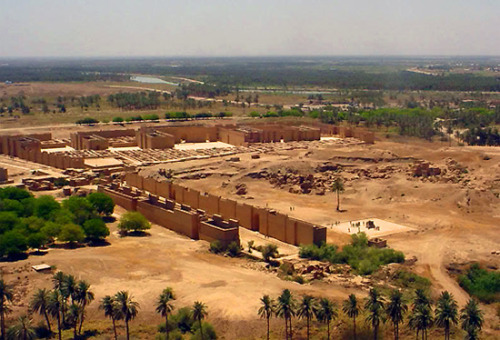
allmesopotamia: City of Babylon, Iraq.
↧
xmorbidcuriosityx: The bizarre burial rituals of Europe’s...

The bizarre burial rituals of Europe’s newly discovered ‘oldest town’: Residents sliced their dead in half and buried them from the pelvis up
Residents of what is thought to be Europe’s oldest town cut their dead in half and buried them from the pelvis up, according to archaeologists.
The newly discovered ancient settlement, thought to date back to 4700BC, is near the Bulgarian town of Provadia, about 25 miles from the country’s Black Sea coast.
Archaeology professor Vassil Nikolov led the dig which focused on the town itself and its necropolis, where the strange and complex burial rituals were discovered.
Full story here!
↧
↧
Archaeological News: Shards of History Found Under Santa Fe Building
Archaeological News: Shards of History Found Under Santa Fe Building:
SANTA FE (AP) — Theo Raven may have found a home for the artifacts excavated from beneath her downtown Santa Fe building.
They are hardly spectacular, but what you would expect in a city at least four centuries old: Chipped stone, animal bones and teeth, scraps of deteriorating leather and newspaper, shards from Pueblo Indian pots and other ceramics, locks of hair or fur, nails, spikes and other corroded metal objects, pieces of glass, beads, a piece of aluminum foil with a piñon shell inside. The state Office of Archaeological Studies believes the items could be used in educational exhibits.
“I really don’t want them,” Raven said recently as she went through two boxes of the items on the back patio of her Tesuque home. “It’s time to clear things out.”
The items were recovered six years ago during an archaeological dig beneath Raven’s building at the northwest corner of Water Street and Don Gaspar Avenue, which houses Doodlet’s and the Sign of the Pampered Maiden on its ground floor. The three-story adobe building, dating to the 1880s, once was a hotel rumored to house prostitutes.

↧
sony-beach: Chalkboard Archaeology

↧
Photo

↧
↧
ancientart: Ancient Egyptian Wall Painting: Woman Holding a...

Ancient Egyptian Wall Painting: Woman Holding a Sistrum, between circa 1250 and circa 1200 BCE (New Kingdom).
The woman in this fragmentary painting from a tomb wall has a wig of long, full hair, held in place by a flowered headband and topped with an ointment cone, a perfumed substance placed on wigs that gave off a fragrant aroma as it melted. A lotus blossom adorns the front of the headband. She holds a rattle called a sistrum, which women often played during temple ceremonies. What remains of the inscription suggests that she may have served with the temple staff of the god Amen.
Currently located at the Walters Art Museum, Baltimore, USA
↧
“The Anthropology Song: A Little Bit...
“The Anthropology Song: A Little Bit Anthropolgist”
This is wonderful!
↧
thesherd: Some impressive murals in this ancient Mayan tomb...

Some impressive murals in this ancient Mayan tomb located in Mexico. (via Archaeologists enter royal tomb in Palenque : Past Horizons Archaeology)
↧
archaicwonder: Jerash Cardo Maximus by sokabs on Flickr. Often...

Jerash Cardo Maximus by sokabs on Flickr.
Often called the ‘Pompeii of the East’ Jerash is one of the largest and finest Roman cities to be found outside of Italy, rivaled only by Ephesus in Turkey. Alexander the Great’s forces started building here in the 2nd century BCE. During the Roman occupation the colonnaded main street was laid out.
↧
↧
stormbear: Images of excavated graves at the Town Creek Indian...


↧
migrantmoonchild: My head is filled with thoughts. Ideas about...

My head is filled with thoughts. Ideas about society that emerge from observation. Thoughts about my daily life and the life of others who live close and far from me. So many ideas and so little people to share them with. What frustrates me is the fact that when I think about organizing those ideas to put them together in the form of writing I become uninterested. Every day I take the metro (subway) at least four times a day and I observe people. I create in my head ideas about religion, culture and society. Most ideas just vanish when I reach my destination or they might stay in my head just for a few days until I observe another thing that enables new thoughts and so on. Today I had the idea of revisiting my blog and, unlike every other idea that is created on my way home from university, I decided to do something about it. I am here to share my thoughts and be heard (or read).
So now I am talking to you who are reading this. Don’t make the mistakes I made. Don’t be afraid of what is inside your head. Speak out and let people know what you are thinking. It would be a pleasure for me to read about it, whatever it is.
↧
arterupestre: Preservation by Buzz Hoffman on Flickr. “Nancy...

Preservation by Buzz Hoffman on Flickr.
“Nancy and Tom discussing preservation issues with rock art sites. Look carefully at the foreground and you’ll see a hoof print petroglyph - an image with significant meaning for this site.”
↧
Archaeological News: Archaeological dig reveals early Boise
Archaeological News: Archaeological dig reveals early Boise:
BOISE, Idaho (AP) — A porcelain-toothed dollhead so creepy archaeologists took to calling it “Chuckie” after the murderous movie doll.
Intact bottles whose stamped glass tells tiny tales: “Sarsparilla, Lowell, Massachusetts.”
A shoe made of scab-brown leather as delicate as papyrus.
A porcelain lid from a jar of “Oriental Toothpaste ” advertised as “England’s Favorite Dentifrice,” guaranteed to “impart a delicate fragrance to the breath.”
Those are some of the 7,000 to 10,000 bits and pieces of Boise history turned up during a two-week excavation in August of an old well on Boise’s Basque block.
University of Idaho archaeologists also found marbles, tobacco tins and shards of flowered china in the well next to the Cyrus Jacobs/Uberuaga House on Grove Street.
↧
↧
lascauxxx: Due to the controversy of the theory of evolution,...

Due to the controversy of the theory of evolution, particularly human evolution, at the time Altamira Cave was discovered, the site was written off as a hoax. Only later was it accepted to be the work of peoples from the Upper Paleolithic.
↧
ancientpeoples: Glass drinking-horn Frankish/Merovingian, 5th...

Glass drinking-horn
Frankish/Merovingian, 5th century CE
From Bingerbrück, Rhineland-Palatinate, GermanyLarge horns such as this would have been passed between guests at feasts and drinking-sessions. The shape of the horn is derived from late provincial Roman models, which in turn imitated vessels made from cattle horns adapted for drinking with metal mounts.
Although the finer skills of Roman glass-makers had been lost, more of the old expertise survived in Lombardic Italy, as shown by a blue glass drinking-horn from Sutri, also in The British Museum.
The color of this horn is typical of post-Roman glass and is probably due to natural salts in the composition.
(Source: The British Museum)
↧
fuckyeahforensics: possible trepanation - a form of surgery...


possible trepanation - a form of surgery potentially used in prehistory to release pressure on the brain. However, a closer look at the find indicated that the skull had been drilled from both sides, indicating that the person was already dead and possibly de-fleshed by the time this modification was carried out. Therefore, what was the purpose of the modification to the human bone?
↧
cornellcas: Faculty and graduate students from Cornell and...

Faculty and graduate students from Cornell and around the world gathered at the Fourth Eurasian Archaeology Conference, held Oct. 11-13 at the Statler Hotel, to explore how archaeology reveals the uneven process of historical transformation and the temporal rhythms of social life.
The relevance of archaeology to present-day concerns was illustrated by the conference’s opening speaker, Mikhail Abramishvili, said Smith. Abramishvili drew parallels between the extreme turmoil at the end of the Bronze Age, when the tin monopoly was broken through widespread access to iron, and the impending contemporary shift from dependence on oil to widely available renewable energy.
“If the analogy holds, we are looking at a large historical period coming up of considerable trouble and disruption,” said Smith.
↧
↧
Europe's oldest prehistoric town unearthed in Bulgaria
Europe's oldest prehistoric town unearthed in Bulgaria:
The walled fortified settlement, near the modern town of Provadia, is thought to have been an important centre for salt production.
Its discovery in north-east Bulgaria may explain the huge gold hoard found nearby 40 years ago.
Archaeologists believe that the town was home to some 350 people and dates back to between 4700 and 4200 BCE.
That is about 1,500 years before the start of ancient Greek civilisation.

↧
Archaeological News: Verde Valley Archaeology Center and Museum to open
Archaeological News: Verde Valley Archaeology Center and Museum to open:
The Verde Valley has been home to tribal communities for thousands of years. From early big-game hunters known as Paleo-Indians to the Sinagua, Apache and Yavapai people, these communities left behind traces of their existence.
Bits of pottery or bone. Rock tools and stone ware
Over the years, when these items surfaced, they were carted off to museums miles away.
The new Verde Valley Archaeology Center and Museum will help keep these artifacts close to the sites where they were found. The center, in downtown Camp Verde, will have an open house from 10 a.m.-4 p.m. Saturday, Nov. 3. If you can’t make it for the open house, the museum is open 10 a.m.-4 p.m. Wednesdays through Mondays. Read more.
↧
Israel’s Ancient Coin Center Rare glimpse of...
↧